
International Casinos for UK Players: Licences and Risks
 Available in GB
An international label does not define an operator’s licence; location and UK regulatory status answer different questions.

Table of Contents
- What “international online casino” actually means in the UK
- Foreign casino sites: the licensing line you need to see
- The industry connections behind one offshore casino deal
- No-deposit bonuses and the real cost of “free”
- When an international casino accepts UK players
- Crypto casinos: faster cash-outs, different risks
- Non-GamStop casinos and the safeguards you leave behind
- Live roulette and what a casino review can—and can’t—verify
- Playing at an overseas casino as a UK player
- Real-money deposits and withdrawals: timing is not a guarantee
What “international online casino” actually means in the UK
“International online casino” sounds like a clear category, but it is not a licence type. It is a loose label for an online gambling operator with some connection to countries outside the UK. That connection might be where the business is based, where it is licensed, or simply the markets it says it serves. Those details are not interchangeable.
When I first looked at international casinos online, I treated “based overseas” and “not licensed in the UK” as if they meant the same thing. They don’t. A company’s location tells you where it is established; its licence tells you which regulator has authorised its gambling operations. The address and the regulatory status answer different questions.
For UK readers, the useful distinction is not whether a site calls itself international, but whether the operator holds a licence from the UK Gambling Commission (UKGC). An operator can be based outside Britain and still hold a UKGC licence for its British-facing gambling business. Conversely, an operator may have an overseas licence and no UKGC licence. The word “international” by itself tells you neither which situation applies nor what oversight covers the site.
In the context of the UK market, a foreign casino means an online gambling operator that accepts British customers without holding a UKGC licence. Such operators are licensed offshore and are not regulated by the UKGC. That is more precise than using “international” as a catch-all: it describes the relationship between the operator, its customers and the UK regulator, rather than relying on a vague suggestion of a global brand.
It helps to separate three ideas when you read a casino’s own description:
- Location: where the business or its corporate operation is based.
- Licence: which regulator has authorised the gambling operation.
- Market: which customers the operator says it accepts.
A site can present an overseas address prominently, but that does not tell you whether it has UKGC authorisation. An offshore licence is not a UKGC licence, even if the operator’s website is in English or refers to British customers. And a business with an international presence is not automatically an offshore casino in the specific sense used here; the relevant point is whether it accepts British customers without UKGC authorisation.
That distinction matters because “international” can sound reassuring without saying anything concrete. It may suggest scale, choice or a polished service, but none of those impressions establishes who regulates the operator. I now read the label as a starting point, not a credential. The regulator is the detail that counts.
There is another easy mix-up: a casino may be international in the ordinary business sense while still operating under different regulatory arrangements in different countries. A company name, a foreign office or an overseas licence does not establish that its UK-facing activity is covered by the UKGC. Nor should a UK-facing webpage, British currency display or familiar wording be treated as proof of that status. These are presentation choices, not a substitute for checking the operator’s regulatory position.
The reverse is worth keeping in mind too. “Foreign” does not simply mean that every part of the company sits abroad. A group may have connections across several jurisdictions, while the gambling operation relevant to a particular customer has its own licensing status. For a British reader, the practical terminology is therefore quite narrow: if the operator accepts British customers without a UKGC licence, it falls into the foreign-casino category described here, regardless of how international its branding sounds.
This is also why I avoid treating “international casino online” as a recommendation in itself. The phrase tells you almost nothing about the operator’s standards or the protections available. Offshore operators do not offer UKGC-mandated affordability checks, and their offshore status does not place them under UKGC regulation. That is not a small wording difference. It is the line between a geographic description and a regulatory one.
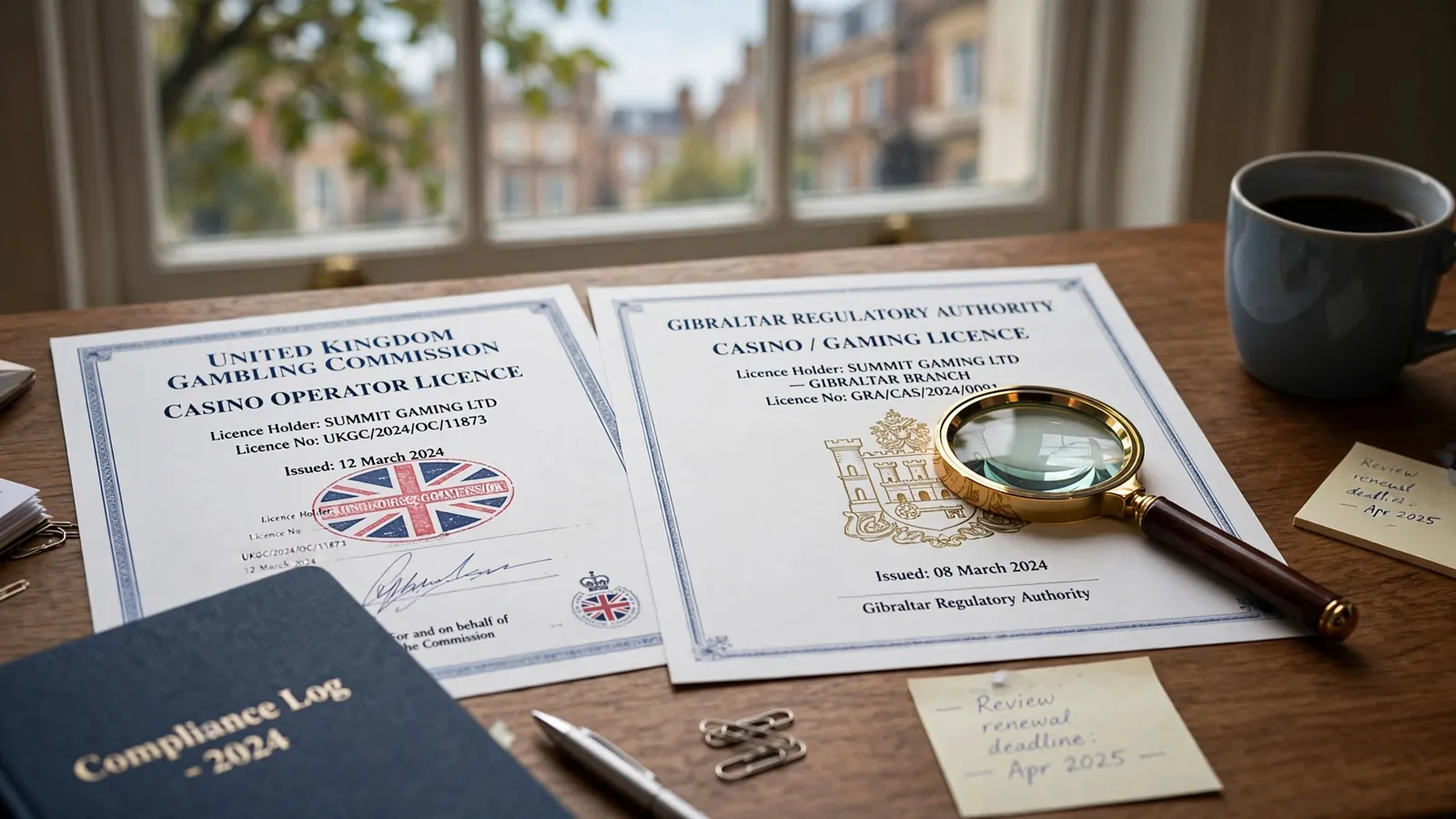
So when you see “international online casinos” used as a broad label, translate it into something more exact before drawing conclusions: where is the operator based, what licence does the gambling operation hold, and does it have UKGC authorisation for the British market? The first answer is about geography. The next answers tell you what the label alone cannot.
Foreign casino sites: the licensing line you need to see
When I look at an international casino site, I separate two questions that are easy to blur together: who regulates the operator, and whether that operator is allowed to offer gambling to customers in Great Britain. A licence from an overseas authority may answer the first question. It does not answer the second.
The UK Gambling Commission (UKGC) regulates gambling operators serving customers in England, Scotland and Wales. An online casino offering its gambling services there must hold the relevant UKGC licence, wherever the company itself is based. A foreign licence does not replace it. Offshore casinos sit outside the UKGC’s regulatory system, so the Commission does not supervise them as it supervises UK-licensed operators.
That is the line I would keep in view when reading claims about an international casino site. A badge or licence number may refer to a real overseas regulator, but it should not be mistaken for UKGC approval. “Licensed” can sound reassuring; the useful question is licensed by whom, and for which market?
The operator’s position is not the player’s
The legal obligation falls on the operator. Without a UKGC licence, an online gambling business cannot lawfully offer gambling services to customers in England, Scotland and Wales. Advertising those services in the UK is also not permitted for an unlicensed operator. In other words, being based abroad does not give a business a pass to sell into the British market.

That is different from making a claim about the customer. The licensing rule is about what the operator may offer, not a statement that every person who visits a foreign site has the same legal status as the business running it. I keep those points separate because phrases such as “illegal casino” can muddle the issue: they may describe an operator’s position in the market, but they do not, by themselves, explain what protections a customer can rely on.
For the customer, the practical difference is more immediate. If a dispute arises with a UKGC-licensed casino, the operator is within the UKGC framework. With an offshore casino, the Commission is not its regulator and cannot be treated as the authority overseeing that operator’s conduct. That does not prove that every foreign site will mishandle a dispute. It does mean the UKGC route is not there in the same way.
A specialist review may make an overseas licence sound like a complete safety check. It is not a substitute for UK regulation. The standards, oversight and routes for raising a complaint depend on the regulator and terms involved, and I would not assume they match the protections attached to a UKGC licence. Offshore operators also do not have to provide the UKGC-mandated affordability checks. That matters: a familiar-looking site does not mean the same safeguards apply.
Where the customer risk shows up
The risk is not just a technical detail about paperwork. If an operator disputes a balance or refuses a withdrawal, a customer may have limited practical ways to make it put things right. Gambling.com has reported cases in which unlicensed sites refused to pay winnings and customers were left without legal recourse. That is a report of cases, not a claim that every offshore casino behaves this way. Still, it is the kind of consequence worth weighing before money is involved.
Payout Risks
Unlicensed sites may refuse to pay winnings, potentially leaving customers without any legal recourse for recovery.
I have learned not to treat a polished website, quick replies from support or a licence badge as proof that a payout dispute will be resolved fairly. Those things can make a site look established, but they do not turn it into a UKGC-regulated operator. The important distinction is not whether the site looks professional; it is which regulator has authority over it and what recourse is available if something goes wrong.
So when comparing international casino sites for UK players, I would not treat an overseas licence as the end of the check. First establish whether the operator holds a UKGC licence for offering gambling in Great Britain. If it does not, the UKGC does not regulate it, and the customer should not assume UKGC-level protections or affordability checks apply. A foreign licence may still be relevant to the operator’s oversight elsewhere, but it is not the same thing.
That is less exciting than a welcome banner. More useful, though.
The industry connections behind one offshore casino deal
An international casino is not just a website with a foreign address. Behind the brand there may be a licence holder, a commercial partner and other businesses with a financial interest in how the operation performs. Those connections can shape incentives, even when they do not change who owns or runs the casino.
A deal involving Santeda and SIS offers a useful example. Santeda’s brands operated under a Curaçao licence, but that licence did not authorise the company to serve customers in the UK or the United States. The commercial arrangement with SIS is notable for a different reason: SIS received a share of revenue generated by losing bets placed through Santeda’s brands.

That detail matters because it links a supplier’s income to customer losses. It does not, by itself, establish that SIS owned a casino brand or controlled Santeda’s operations. But it does make the relationship more than a simple supplier arrangement paid at a fixed rate. The financial incentive is worth understanding when you are assessing who benefits from a casino’s business.
I used to stop at the name on the homepage. It looked like the whole story. It wasn’t.
Follow the relationship, not just the logo
Casino brands can make a business look self-contained: one name, one site, one set of terms. In practice, commercial relationships may sit further back in the chain. A company can supply a service, license technology, introduce customers or agree to revenue sharing. Those arrangements are not interchangeable, and calling every partner an owner would blur important distinctions.
The Santeda–SIS arrangement shows why the wording of a deal matters. SIS’s share was tied to revenue from losing bets made through Santeda brands. That is a specific financial connection. It is not the same as saying SIS owned those brands, held Santeda’s licence or made every decision about the casino.
For a player trying to understand an international casino, the useful question is not simply, “Who is behind this name?” It is also, “What is each party paid to do, and what outcome affects that payment?” A revenue link to losses can raise a question about incentives. It does not prove misconduct, but it gives you a reason to look beyond polished branding.
That distinction is easy to miss when a company’s name appears beside a familiar sports or entertainment business. Recognition can create a sense of reassurance that the relationship itself may not justify. A commercial partner’s reputation is not a substitute for knowing which company operates the casino and which regulator, if any, has authority over it.

Why the connection matters to UK players
The licence and the commercial arrangement answer different questions. Santeda’s Curaçao authorisation did not extend to operating in the UK or the US. Separately, the SIS contract described a payment linked to losing-bet revenue. One point concerns the reach of a licence; the other concerns how two businesses shared income.
Keeping those points apart helps avoid two opposite mistakes. You should not treat a partner’s involvement as proof that a casino is safe or properly authorised for British customers. Nor should you treat a revenue-sharing clause alone as proof that the partner controlled the operator or behaved improperly. The detail supports a narrower conclusion: commercial incentives can be relevant, and the relationship deserves to be described precisely.
When I look at a casino brand now, I try to separate the visible name from the companies around it. Who runs the gambling operation? Who holds the licence? Which businesses have a financial stake, and what is that stake connected to? Those are different questions, not boxes that one famous partner can tick all at once.
The Santeda deal is a reminder that the word “partner” can cover very different arrangements. A company paid from losing-bet revenue has a different commercial link from one paid a fixed fee, even if neither arrangement tells you the full story of day-to-day control. That is the point worth carrying forward: follow the money carefully, but do not turn one contract detail into a claim it cannot support.
Read the relationship for what it is. No more, no less.
No-deposit bonuses and the real cost of “free”
A no-deposit bonus sounds like the casino is handing you something for nothing. I’ve learned to read that as “no initial deposit required”, not “no conditions attached”. The money or spins may be promotional funds, and the rules can decide whether any winnings become withdrawable at all.
Specialist reviews of foreign casinos serving UK players describe four recurring offer formats: deposit matches, free-spins packages, no-deposit bonuses and cashback. A match adds bonus funds in relation to a deposit; free spins are limited plays on selected slots; a no-deposit offer gives a small bonus or spins without an initial deposit; and cashback returns some amount calculated under the promotion’s terms. The labels are the easy part. The restrictions are where I slow down.
The appeal is obvious. A specialist review reports that foreign casinos can advertise larger welcome packages because they are not bound by UKGC rules on bonus terms, wagering requirements and promotional language. That can make an international casino welcome bonus look generous beside a UK offer. But a bigger headline number does not tell you what you can actually keep, and it does not mean the operator is regulated by the UK Gambling Commission. Offshore casinos sit outside the UKGC system and do not have its protections, including UKGC-mandated affordability checks.
The key phrase is “wagering requirement”. In plain English, it sets how much you must stake on qualifying bets before bonus funds, or winnings linked to them, can be withdrawn. A specialist review illustrates the arithmetic this way: if a £20 bonus carries a 35-times wagering condition, the qualifying bets add up to £700. That is turnover, not a bill you pay once, but it still means repeated betting before cash-out eligibility. You can lose the balance along the way.
Wagering Calculation
A casino provides a £20 no-deposit bonus.
With a 35-times wagering requirement, the calculation is £20 × 35.
You must place £700 in qualifying bets before any winnings become withdrawable.
The same review uses a larger match offer to show how quickly the number grows. If a casino matches a £100 deposit in full and attaches a 35-times requirement to the £100 bonus, you would need £3,500 in qualifying stakes before those bonus funds could convert to withdrawable cash. The important point is what amount the multiplier applies to. Terms may calculate it against the bonus, the deposit, or both, so don’t assume the headline offer tells you.
“Free spins” can have conditions too: check which games are included, whether winnings are capped, and whether those winnings carry a wagering requirement. Cashback needs its own close read as well; the word does not explain how the return is calculated or whether it arrives as cash or bonus credit. I would not count any offer as money in my pocket until I can explain its conditions back to myself.
For any promotion, look for the qualifying games, expiry rules, maximum cash-out and the exact wagering calculation. If those terms are hard to find or unclear, that is a reason to walk away, not a puzzle to solve after signing up. A no-deposit bonus can be a way to try a site’s games, but it is not a risk-free route to cash. “Free” has fine print.
When an international casino accepts UK players
Choosing an international casino as a UK player means weighing the information available about how it handles withdrawals. Use the listed payout speed as one practical detail when considering your options.
Payout speed: 1-3 business days x3bet lists a payout speed of 1–3 business days, giving you a stated timeframe to consider.
Payout speed: 1-3 business days NightWin lists a payout speed of 1–3 business days, giving you a stated timeframe to consider.
Payout speed: 1-3 business days Amunbet lists a payout speed of 1–3 business days, giving you a stated timeframe to consider.
Payout speed: 1-3 business days WinBeast lists a payout speed of 1–3 business days, giving you a stated timeframe to consider.
Payout speed: 1-3 business days Jetsetspins lists a payout speed of 1–3 business days, giving you a stated timeframe to consider.
Payout speed: 1-3 business days Chanze lists a payout speed of 1–3 business days, giving you a stated timeframe to consider.
Payout speed: 1-3 business days EvoSpin lists a payout speed of 1–3 business days, giving you a stated timeframe to consider.
Payout speed: 1-3 business days SpinFormula lists a payout speed of 1–3 business days, giving you a stated timeframe to consider.
Payout speed: 1-3 business days Dieselwin lists a payout speed of 1–3 business days, giving you a stated timeframe to consider.
Payout speed: 1-3 business days Revery Play lists a payout speed of 1–3 business days, giving you a stated timeframe to consider.
A site loading on your phone can feel like a clear answer: it accepts you. I’ve learned to separate “the page opens” from “the operator is meant to serve customers in Britain”. They are not the same thing.
A report by gambling.com says some casinos without a UK licence are supposed to block visitors from Britain, yet may not apply that restriction consistently. It also reports that a basic VPN can get around an access block. That describes a possible technical route to a website, not permission from the operator or a change in its regulatory status.
A VPN can make it appear that your connection comes from somewhere else. If a site has blocked British visitors, getting past that barrier does not make it a UK-licensed casino, and it does not give you the protections that come with using a UKGC-regulated operator. The screen may look unchanged. The underlying position is not.
This is where the wording on a landing page can mislead. “Available to UK players” may mean the site is reachable, or that it has not stopped your visit; it is not proof that the operator is entitled to provide gambling facilities to customers in Great Britain. Without a UK Gambling Commission licence, an operator cannot legally offer those services to British customers or advertise them in the UK. Access and authorisation are different questions.
The same applies if you arrive through an app, or see a promotion for free spins. An app is another way to reach a service, not evidence of a UK licence. And a bonus banner does not establish that the offer is intended for you or that the operator is authorised to serve you. “It works” is a thin test. A thin test.
I would not treat a successful sign-up, a deposit screen, or a working game as proof that the site has formally accepted UK customers. Those steps show what the website lets you do at that moment. They do not establish the operator’s legal position, and they do not tell you what will happen if it later restricts access.

So when you encounter an international casino that appears to accept UK players, read the apparent welcome for what it is: a sign that the site is reachable, not a regulatory green light. A VPN may change what you can see online. It cannot turn an offshore casino into a UKGC-licensed one.
Crypto casinos: faster cash-outs, different risks
Crypto can make a withdrawal feel almost instant, but speed is only half the story. With an international casino, the balance may be paid in a cryptocurrency rather than pounds, so what arrives in your wallet can change in value before you convert it or spend it.
A specialist casino review reports that crypto withdrawals at foreign casinos can clear in under an hour, faster than fiat withdrawals. Treat that as a reported possibility, not a promise: the operator’s own checks and processing rules still matter. A quick transfer does not make the money’s value stable.
That is the bit I used to ignore. I’d see “fast cash-out” and think the amount on screen was the amount I’d keep. With crypto, the value can move while a withdrawal is waiting or after it reaches your wallet. If the price falls before you exchange it, the pounds you receive may be worth less than you expected. If it rises, that can go the other way too. There’s no fixed exchange rate built into the casino’s headline.
Before choosing crypto, check which currency the casino uses for deposits and withdrawals, whether it converts your balance, and what fees apply at each step. Also make sure you understand how to receive the payment safely. A wallet address is not something to guess at or copy in a rush; a transfer sent to the wrong address may not be recoverable.
Crypto is a payment option, not a shortcut around the questions that matter. The casino may still require account checks, and a fast blockchain transfer cannot settle a dispute about whether a payout is owed. Nor does accepting crypto make an offshore casino regulated by the UK Gambling Commission. Offshore operators are not covered by UKGC rules, including its requirements around affordability checks.
I’d judge the offer by the amount I could realistically convert into pounds, not by the speed in the advert. If the balance is held in crypto, consider whether you can tolerate its value moving before you cash out. If you need a predictable sum, that uncertainty is part of the cost.
Fast transfer. Unsteady value.
Non-GamStop casinos and the safeguards you leave behind
GamStop is not a general block on gambling websites. It covers every operator licensed by the UK Gambling Commission, so registering with the scheme shuts off access to UK-licensed sites. Casinos outside the UKGC system are not connected to GamStop. That gap is the point to take seriously.
A specialist review reports that someone who has self-excluded can register with a foreign casino and deposit without the safeguards attached to that exclusion. The process may look like a fresh start; it is not a reset of the reasons you signed up. If you used GamStop because gambling was becoming difficult to control, moving to a site beyond its reach removes a barrier you deliberately put in place. I would treat that as a warning, not a workaround.
Attention: Moving to a non-GamStop casino removes the barriers you deliberately put in place if gambling was becoming difficult to control.
There is another important difference: offshore casinos are not regulated by the UKGC and do not provide UKGC-mandated affordability checks. A licence from another authority, where an operator has one, does not make the site UKGC-regulated or give you the same protections. A specialist review may describe some platforms as licensed by other authorities or as using encryption to protect customer information. Those claims are not a substitute for checking what regulator is named, whether the licence can be verified, and what support or complaint routes actually exist.
Encryption addresses the handling of information; it does not guarantee that an operator will intervene if your gambling becomes harmful. Nor does a foreign licence reconnect the site to your GamStop exclusion. Different protections. Different limits.
If you are already self-excluded, pause before creating an account elsewhere. Consider blocking access to gambling sites on your devices and talking to someone you trust or a gambling support service. The aim is not to find a platform that will accept you; it is to preserve the boundary you chose.
“Non-GamStop” can sound like a feature. In practice, it means the scheme cannot enforce your exclusion there. That distinction matters more than claims about international casino games, welcome offers or a polished registration screen. A smooth sign-up is not evidence of safer play, and an operator’s security language does not recreate the safeguards you left behind.

Live roulette and what a casino review can—and can’t—verify
Live roulette can look reassuringly straightforward: a wheel on screen, a dealer, and familiar bets. I’ve learned not to treat a polished table as evidence that the rest of the casino experience will be just as smooth. A review can describe what it has checked, but it cannot turn an operator’s terms into a promise about how your own withdrawal will go.
That matters when comparing international live-casino sites. A review may outline the published cash-out rules and the identity checks an operator says it applies. But limits on withdrawals, waiting periods before a request is processed, and verification procedures differ between operators. They can affect a player far more than the roulette table’s presentation does. Read the relevant terms before depositing, and look for the conditions attached to withdrawals rather than relying on a general “fast payouts” claim.
A specialist review is useful only to the extent that it explains what was actually examined. Does it distinguish the operator’s stated policy from a test of the withdrawal process? Does it say whether identity documents were requested, and at what stage? If it simply gives a broad verdict, it may tell you little about the practical details that matter once you want your money back.

I would also keep a review’s date and scope in mind. Terms can change, and a past account of one player’s experience does not establish what will happen to another. Even a detailed write-up cannot settle every case in advance. Small print still counts.
For a live roulette player, the sensible comparison is not just the look of the table or the promise of a live dealer. Check the operator’s withdrawal rules, pending periods and verification requirements directly, and make sure you understand them before you play. A review can help you know what to inspect; it cannot guarantee that the process will match an advertisement or another player’s account.
A neat interface is not a payout policy.
Playing at an overseas casino as a UK player
The legal position is easy to muddle because two different questions get treated as one: whether you, as a player, can be punished for placing a bet, and whether an operator is allowed to offer gambling to people in Great Britain. They are not the same thing.

There is no UK law that makes it a criminal offence for an individual to bet with a casino licensed overseas. The Gambling Act does not impose a fine or other criminal penalty on a player simply for using a foreign casino. So if you are looking up international casinos for UK players, don’t mistake the operator’s licensing position for your own criminal liability.
That distinction is not an endorsement. Remote operators offering gambling to customers in England, Scotland and Wales must hold a UK Gambling Commission licence. A casino’s overseas licence does not give it permission to provide services in Great Britain without that UK licence. The operator’s legal obligations remain separate from the player’s position.
I used to read “not illegal for players” as shorthand for “nothing to worry about”. That was too convenient. It answers one narrow question; it does not tell you that a site is authorised for the British market, or that you have the protections available through a UK-licensed operator. Offshore casinos are not regulated by the UK Gambling Commission and are not subject to its enforcement or UK-mandated affordability checks. Don’t blur those lines.
Tax is more straightforward. Gambling winnings are not subject to UK income tax, whether the casino is licensed by the UK Gambling Commission or by an overseas authority. That tax treatment does not change the operator’s licensing duties, and it does not turn an offshore casino into a UK-licensed one.
So the useful distinction is this: a British player does not commit a criminal offence merely by betting with an overseas casino, but that does not make it lawful for an unlicensed operator to offer gambling services in Great Britain. Those are separate sides of the same transaction. Keep them separate when weighing the risks.
Real-money deposits and withdrawals: timing is not a guarantee
When I compare payment methods at an international casino, I separate the operator’s processing time from the time a payment takes to reach my account. The advertised speed can describe only one part of the journey.
A specialist review of foreign casinos reports that Skrill and Neteller withdrawals are often processed within a day, with many cleared in less than twelve hours. That is a useful comparison point, not a promise about your cash-out. The casino may still need to review the request, and its own rules can affect when it releases the money.
Bank transfers are generally the slower option. A specialist review puts the banking journey at five to seven business days, and notes that some offshore casinos add their own processing time before the transfer is sent. Weekends and bank holidays can make the wait feel longer. So “sent” and “received” are not the same thing.
I used to judge a payment method by the fastest number on the page. That was my mistake. The key detail is whether the casino counts its internal review as part of the quoted timeline, and whether the estimate starts when you request a withdrawal or when it is approved. Read the payment terms before depositing, and check for separate processing and bank-transfer stages.
Deposits and withdrawals may also follow different rules, even when the same method appears in both menus. Before putting real money in, confirm that the route you plan to use is available for withdrawals and note any operator-specific conditions. Offshore casinos are not regulated by the UK Gambling Commission, and they do not have to follow UKGC-mandated affordability checks. That matters beyond payment speed: a polished cashier page does not tell you what protection applies if a payment is delayed or disputed.
Fast on paper. Wait in practice.
Are bonuses at foreign casinos actually better than at UKGC-licensed sites?
Often, yes: foreign casinos commonly offer larger welcome packages because they are not bound by UKGC restrictions on bonus terms and promotions. Check the wagering requirements carefully; a larger bonus may require substantial qualifying bets before you can withdraw bonus funds.
Is playing at an international casino legal for UK residents?
Yes, there is no UK law prohibiting you from betting with an overseas operator. However, operators without a UKGC licence cannot lawfully offer gambling services to customers in England, Scotland and Wales.
Are gambling winnings subject to income tax in the United Kingdom?
No. Gambling winnings are not subject to UK income tax, whether they come from a UKGC-licensed or foreign casino.
How long do withdrawals take at the listed operators?
Timing depends on the payment method and the operator’s processing, verification and pending procedures. E-wallet withdrawals are often processed within 24 hours, bank transfers can take five to seven business days, and crypto withdrawals often clear in under an hour.
Are foreign casinos safe for UK players to use?
They do not have UKGC oversight, and some unlicensed sites have refused to pay winnings, leaving customers with no legal recourse. Check who licenses the operator and understand that an offshore licence does not provide UKGC protections.
Is it legal for UK residents to use casino sites that operate outside the UK’s licensing framework?
You are not committing an offence by playing at an overseas casino. But an operator without a UKGC licence cannot lawfully provide gambling facilities to customers in England, Scotland and Wales or advertise its services in the UK.
Are winnings from foreign casinos taxable in the UK?
No. UK gambling winnings are not subject to income tax, including winnings from foreign casinos.
Can I use cryptocurrency at foreign casinos from the UK?
Yes, some foreign casinos offer cryptocurrency as a payment option. Crypto withdrawals often clear in under an hour, but the value can fluctuate.
Created by the ”Tenobet Casino 2” editorial team.