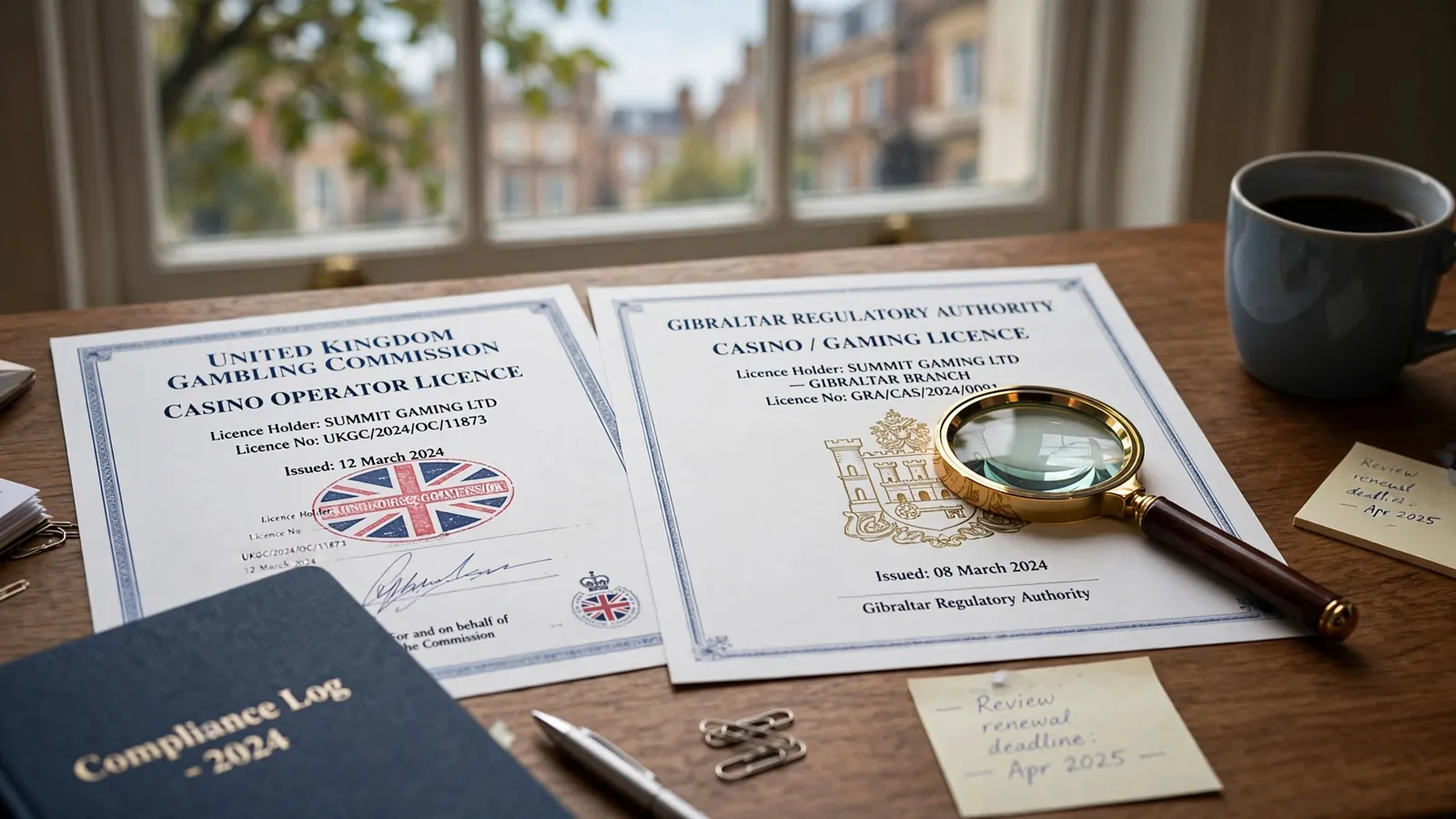
Non-UK regulated casinos: UK rules and licences
 Available in GB
The guide explains how UKGC oversight differs from offshore licensing, and what that can mean for payments, withdrawals and player protection.

Table of Contents
- What UKGC Regulation Actually Means for an Online Casino
- Are UK Players Breaking the Law by Using an Offshore Casino?
- “Unregulated” Doesn’t Always Mean Unlicensed
- Outside the UKGC and Outside GamStop: What That Changes
- Payments, Bonuses and Withdrawals: Read the Small Print
- Licences Outside the UK: Why the Jurisdiction Matters
- Do Slot Machines Follow Different Rules?
- Crypto Casinos and the Rules Around Their Payments
- What the Gambling Commission Can—and Can’t—Do for You
- How to Check a Casino Licence Before You Trust It
What UKGC Regulation Actually Means for an Online Casino
When people say an online casino is “UK regulated”, they mean its operation for customers in Great Britain falls under the oversight of the UK Gambling Commission (UKGC). The key point is where the operator serves customers, not where its offices are or where the company was formed. An operator serving Great Britain needs a UKGC licence, wherever it is based.
That distinction is easy to miss. A company can be based outside the UK and still need a UKGC licence if it serves customers in Great Britain. A foreign address does not, by itself, put the operator outside the Commission’s rules. Equally, being available on a British screen does not make a casino UK-regulated. The operator’s licensing status is what matters.
I used to treat “regulated” as a reassuring label, almost as if it meant a site had been checked in every possible way. That is too broad. It tells you that the operator is under the relevant regulator’s oversight for the market it serves. It does not mean every casino with a polished website has UKGC approval, or that a company’s base of operations settles the question.
If you’re considering casinos outside UK regulation, check the available information carefully before deciding where to play. The entries below give you the stated payout-speed detail for each operator.
Payout speed: 1-3 business days x3bet lists a payout speed of 1–3 business days. This gives you a stated timeframe to consider when reviewing the operator.
Payout speed: 1-3 business days NightWin lists a payout speed of 1–3 business days. Use this stated timeframe as one detail to consider.
Payout speed: 1-3 business days Amunbet lists a payout speed of 1–3 business days. This is the available detail here to help you assess the operator.
Payout speed: 1-3 business days WinBeast lists a payout speed of 1–3 business days. You can take this stated timeframe into account when considering it.
Payout speed: 1-3 business days Jetsetspins lists a payout speed of 1–3 business days. That is the payout information available for you to consider.
Payout speed: 1-3 business days Chanze lists a payout speed of 1–3 business days. Keep this stated timeframe in mind when reviewing the operator.
Payout speed: 1-3 business days EvoSpin lists a payout speed of 1–3 business days. This gives you a stated payout timeframe to weigh in your decision.
Payout speed: 1-3 business days SpinFormula lists a payout speed of 1–3 business days. This is the only supplied detail to guide your assessment.
Payout speed: 1-3 business days Dieselwin lists a payout speed of 1–3 business days. You have this stated timeframe as a point of reference.
Payout speed: 1-3 business days Revery Play lists a payout speed of 1–3 business days. Consider this stated timeframe as part of your review.
What the licence tells you
For a UK-regulated online casino, the UKGC is the regulator responsible for overseeing the operator’s activity in Great Britain. The licence is the dividing line between an operator authorised to serve this market under the UK system and one that is not UKGC-regulated.
So, when you are trying to work out which online casinos are licensed and regulated in the UK, start with the operator rather than the game, brand style or country shown in a footer. The practical question is whether the company serving customers in Great Britain holds the appropriate UKGC licence. Familiar games, a British-facing website or a UK payment option do not answer that question on their own.
The wording can be slippery. A site might describe itself as “licensed”, but that could refer to a licence from somewhere other than the UK. That is not the same as being licensed by the UK Gambling Commission. The word “regulated” only makes sense when you know who the regulator is and which market the licence covers.
In plain terms: UKGC oversight is tied to serving Great Britain under the UK licensing system. It is not a badge a company earns simply by being a casino, and it does not travel automatically with a brand from one country to another.
Location is not the test
The rule about operators serving customers in Great Britain applies regardless of their base of operation. That means a business cannot sidestep the UKGC requirement merely by placing its headquarters abroad. The relevant issue is the market it serves.

This is why “UK-based” and “UK-regulated” are not interchangeable descriptions. One refers to where a business is based; the other refers to the regulator overseeing its operation for the British market. A non-UK-based operator may be UKGC-regulated if it serves Great Britain under the required licence. A site does not become a regulated UK online casino just because it looks local or uses British wording.
I find it useful to keep those two ideas separate when reading casino pages. A location claim can be about the company’s registered address, its staff, or its business structure. None of those details changes the basic licensing requirement for an operator serving Great Britain.
The regulated-versus-offshore distinction
The phrase “online casinos regulated outside the UK” can sound as though those casinos are simply another kind of UK-regulated site. They are not. A regulator outside the UK and the UK Gambling Commission are different authorities, and a licence from one does not equal a UKGC licence.
That is the point behind the distinction between UK-regulated casinos and non-UK-regulated casinos: the latter operate without UKGC oversight. The label says something about the regulator, not necessarily about the operator’s address. It is possible for an operator to be based abroad and still be within the UK system; what matters is whether it has the UKGC licence required to serve Great Britain.
UKGC oversight is tied specifically to serving the Great Britain market under the UK licensing system, regardless of where the operator’s headquarters are located.
If you are asking whether online casinos are regulated, the answer depends on the operator and the market. UK-regulated online casinos are overseen by the UK Gambling Commission. For an operator serving customers in Great Britain, the requirement does not disappear because the company is located elsewhere. That is the basic test—not how confidently a website describes itself, and not whether its branding feels familiar.
I would not treat “best regulated online casinos” as a meaningful category until that distinction is clear. “Best” is a judgement; the UKGC licence is a specific regulatory status. First establish which regulator covers the operator’s activity in Great Britain. Then you know what the label actually means.
Are UK Players Breaking the Law by Using an Offshore Casino?
The legal position is easy to muddle because two different questions get bundled together: what an operator is allowed to do, and whether a player can be prosecuted for using a gambling service based abroad. I used to treat those as the same issue. They aren’t.
The Gambling Act 2005 is aimed at businesses that provide gambling services to the UK market. It does not make an individual player the target simply for placing a bet. So if you are trying to understand the position of UK players using a non-UK-regulated casino, start by separating the operator’s obligations from the player’s legal status.

The rule is directed at operators
An operator that supplies gambling services to customers in Great Britain needs the relevant UK Gambling Commission licence, wherever the business itself is based. A company does not avoid that requirement just by being registered overseas or by describing its site as international. The focus is on the service being offered into the British market.
That is the regulatory question: whether the operator is authorised to serve customers here. It is not the same as asking whether a customer commits a crime by logging in or placing a wager. The legal framework places the licensing duty on the business.
This distinction matters because phrases such as “not permitted in the UK” can sound as though they describe the player’s conduct. Often they are referring to the operator’s position instead. I’ve read those warnings too quickly before and assumed they meant the customer could be prosecuted. That is not what the law says about the player.
What about the person using the site?
UK law does not expressly make it an offence for a British citizen to use a gambling service that is licensed in another country. More broadly, a player does not commit a criminal offence under UK law simply by gambling on a site that lacks a UK licence.
That does not turn the operator’s activity into a UK-authorised service, and it does not erase the operator’s licensing obligations. It means the legal responsibility described here falls on different sides of the transaction: the operator must meet the rules for serving the British market, while the player is not criminally liable merely for using an unlicensed site.
Legal Liability
While using an unlicensed site is not a criminal offence for the player, the operator remains legally responsible for complying with rules when supplying services to the British market.
It’s a narrow point, but an important one. “The player is not committing a criminal offence” is not the same statement as “the site is legal to operate here.” I’ve seen those ideas blurred together in casual discussions, and the result is usually more confusion, not less.
A careful reading of “legal”
There is another source of confusion: people use “legal” to mean several things. They may mean that an operator holds permission to offer gambling in Great Britain, or they may mean that a customer risks prosecution for using a particular service. Those are separate questions, with separate answers.
For operators serving Great Britain, a UK Gambling Commission licence is required. For an individual player, UK law does not explicitly prohibit using gambling services licensed elsewhere, and gambling on an unlicensed site does not itself amount to a criminal offence. Keep both points in view rather than letting one stand in for the other.
That distinction also helps when reading claims about non-UK-regulated casinos accepting UK players. A site’s availability to a customer does not prove that the operator has the UK permission required to serve the market. At the same time, the absence of that UK permission does not mean the player has automatically committed a crime by using the service.
No clever loophole. Just different duties.
What this does—and does not—settle
The player’s position cannot be used as a shortcut to answer the operator’s licensing question.

So, if you are a UK player asking whether using an offshore casino automatically makes you a criminal, the answer is no: UK law does not impose criminal liability on a player solely for gambling on an unlicensed site. But the operator is still responsible for complying with the rules that apply when it supplies gambling services into the British market.
I would keep that wording precise. “A player is not committing an offence” is not a blanket statement that every aspect of the arrangement is lawful, or that the operator has permission to serve customers here. It answers one question only: whether the player is criminally liable just for taking part.
“Unregulated” Doesn’t Always Mean Unlicensed
The word “unregulated” sounds like a site has no rules at all. That is not necessarily what it means here. A non-UK-regulated casino is one that operates without oversight from the UK Gambling Commission. It may still claim to hold a licence from another jurisdiction.
That distinction matters. “Not regulated in the UK” describes the casino’s relationship with the UKGC; it does not, by itself, tell you whether another authority has licensed it. I used to treat the two phrases as interchangeable. They aren’t.
What the label does—and doesn’t—tell you
A UK-regulated casino is overseen under the UKGC system. A casino without that oversight sits outside that system, even if its website displays a licence from somewhere else. The foreign licence may be relevant, but it does not turn the operator into a UK-regulated casino.
What does a foreign licence mean?
A licence from another jurisdiction tells you that an operator has authorisation from a named authority, but it does not guarantee the same supervision standards or player protections as the UKGC.
Nor does the word “licensed” settle every question about a site. It tells you that an operator says it has authorisation from a named jurisdiction. It doesn’t automatically tell you how closely that authority supervises the operator, what standards it requires, or what help a player can expect if something goes wrong. Those details depend on the regulator and its rules.
So I would read “internationally licensed” as a description, not a quality mark. It can sound reassuring, but the useful question is: licensed by whom, under what system? A badge on a homepage is only a claim until you know what it refers to.
The jurisdictions you may see
Non-UK-regulated casinos are commonly associated with licensing jurisdictions such as Malta, Curaçao, Gibraltar and Anjouan. These names are not interchangeable, and a licence from one does not mean the same thing as a licence from another. Each jurisdiction has its own regulator and framework.
That is why “foreign licence” is a broad label rather than a single standard. Two sites may both call themselves licensed while being accountable to different authorities. You cannot tell how meaningful that accountability is just from the shared word.
I also try not to confuse the place a company is based with the place that issued its licence. A casino can operate under a licence from a jurisdiction different from its company’s home, so the brand’s address alone may not explain who supervises its gambling service. Read the licence wording carefully.

There is a similar muddle around the phrase “unlicensed casino”. Sometimes people use it to mean “not licensed by the UKGC”; sometimes they mean the operator has no licence at all. Those are different claims. If a site is described as unlicensed, check whether the speaker means it lacks UK authorisation specifically or whether it has no licence from any authority.
What about crypto casinos?
Crypto does not, by itself, identify a regulator. A casino that accepts cryptocurrency is still an online gambling operator; the payment method does not answer who, if anyone, licenses it. To understand its status, look for the operator’s stated licensing jurisdiction rather than assuming that using crypto makes the site part of a separate regulatory category.
That small distinction saves a lot of confusion. “Crypto casino” describes something about how a site may take payments. “UK-regulated” or “licensed in another jurisdiction” describes its regulatory position. They are not competing labels.
A more careful way to read the wording
When a site calls itself “regulated”, I look for the name of the authority behind that claim. When it says “international licence”, I look for the jurisdiction. If the wording stays vague, I don’t fill in the blanks for the operator.
None of this makes a foreign licence meaningless. It means its meaning depends on the authority that issued it and the rules attached to it. The label alone cannot tell you whether the protections match those of a UKGC-regulated casino, or what route exists if you have a dispute. Those are separate questions, and they deserve a closer look than a logo gets.
- Look for the name of the specific authority behind a “regulated” claim
- Identify the exact jurisdiction of an “international licence”
- Verify the licence details on the regulator’s public register
- Assume a badge is a quality mark without checking the regulator
- Let a single reassuring word replace a full regulatory check
- Fill in the blanks for an operator that uses vague wording
I’ve learned not to let one reassuring word do all the work. “Licensed” is a starting point, not a verdict. A casino can be licensed elsewhere and still be outside UKGC oversight; both things can be true at once.
Outside the UKGC and Outside GamStop: What That Changes
GamStop is the UK Gambling Commission’s self-exclusion scheme. A casino that sits outside the UKGC system is not part of it, so registering with GamStop does not bring that casino into the scheme. That distinction matters: GamStop is not a universal switch that controls access to every gambling site.
I used to treat the phrase “not on GamStop” as if it described a separate kind of protection. It doesn’t. It tells you the site is outside that particular self-exclusion system. It does not tell you whether the operator has a meaningful alternative, how easy it is to set limits, or whether a request to close an account will be handled as you expect. Those details depend on the operator and its rules.
The protection gap is practical
UKGC-licensed operators are subject to requirements around responsible gambling and customer data. A non UK regulated casino may follow a different standard, and the protections it offers may be less demanding. Don’t assume that tools you recognise from a UK casino will work in the same way elsewhere—or be available at all.
In practical terms, check what the site lets you do before depositing: can you set a deposit limit, take a break, or exclude yourself from that operator? Look for clear instructions and a way to contact support. If the only controls are vague promises to “play responsibly”, that tells you little about what happens when you ask to restrict your account.

This is where I’d slow down. A responsible-gambling page can look reassuring while leaving the important details unclear. Read the actual terms for how limits and self-exclusion work, and whether the operator can change or remove them. A tool is only useful if you can understand it and rely on the process.
Data handling deserves the same attention. Sites outside UKGC oversight may apply weaker data-protection rules than UK-licensed operators. Before sharing identity or payment information, look for a privacy policy that explains what information is collected, why it is used, and how to contact the company about it. A polished site design is not proof of strong safeguards.
What “outside GamStop” does—and doesn’t—mean
Casinos not on GamStop are not enrolled in the UK scheme. That does not mean GamStop has blocked them, nor that it controls whether you can reach them. It means the scheme’s self-exclusion does not cover those operators. If you have excluded yourself through GamStop, relying on that alone to keep you away from every gambling site leaves a gap.
The same caution applies to non-GamStop casinos, including Curaçao casinos not on GamStop: the label does not establish what protections the operator offers. Check the site’s own terms and controls rather than reading the phrase as a safety rating. If you need a broad barrier to gambling, an operator-specific setting may not be enough; consider support beyond the casino itself.
Attention: If you use a non-UK-regulated casino, you lose access to the UK’s Financial Ombudsman Service and the mandatory responsible-gambling tools of the UK system.
There is also a change in where you can turn for help. When you gamble with an offshore operator, you give up access to the UK’s Financial Ombudsman Service and to the mandatory responsible-gambling tools attached to the UK system. That is not just paperwork. It can leave you with fewer formal protections if a control fails or a concern about your information arises.
I wouldn’t treat “outside GamStop” as a feature. It describes a gap in coverage, and the operator’s own promises do not automatically fill it.
Payments, Bonuses and Withdrawals: Read the Small Print
A deposit menu can look generous: offshore casinos may accept cards, e-wallets, bank transfers and cryptocurrencies, sometimes using alternative payment processors. But a method appearing on the deposit page does not necessarily mean it will be available when you cash out. Check the withdrawal terms separately before sending money.
I learned that the hard way. A payment going in smoothly tells you very little about how a payout will work. The casino may require you to withdraw through a particular method, complete extra checks, or follow limits that make a larger balance arrive in instalments. Some specialist reviews report daily, weekly or monthly withdrawal caps at particular casinos; treat those as operator-specific terms, not a rule that applies everywhere.
Timing is not consistent either. Reports give conflicting pictures: one commonly cited range for withdrawals at Casinos not on GamStop is 24 hours to 5 business days, depending on the payment method, while another account says payouts at non-UK-regulated casinos can take three or four weeks. The point is not to assume either estimate applies to your account. Check the casino’s terms and bear in mind that there is no regulatory clock enforcing a payout deadline.
Verification can add another pause. A casino may ask for documents before releasing funds, and some specialist reviews describe operators requesting notarised documents or a video call. Those are reports about particular cases, not standard requirements across the market. Still, if a withdrawal is delayed, frozen or made conditional on an unexpected check, the practical burden falls on you.
Then there is the word “bonus”. It can mean money with strings attached. Specialist reviews describe some offshore welcome offers with wagering requirements of 35x or more; the calculation may apply to the bonus and deposit together, the bonus alone, or a bonus and free spins combined. The exact terms matter more than the headline figure. A requirement attached to free-spin winnings can also be separate from the main offer.
Free spins deserve their own small-print check. Specialist reviews report offers where winnings carry wagering requirements of 30–50 times the winnings, alongside cash-out caps of £5–£50. They also describe packages that expire within 24–72 hours. These are reported examples, not a promise that every casino uses those terms; read the offer shown to you and check what happens when its clock runs out.
Check Before Depositing
- Verify the available withdrawal methods
- Review processing conditions and payout caps
- Check verification rules and required documents
- Read the full bonus terms and wagering requirements
- Confirm the expiry date of any free spin offers
Before accepting anything, look for the withdrawal method, processing conditions, any caps, verification rules and the full bonus terms. If the wording is vague, ask support to explain it before depositing and keep a copy of the answer. “Fast cashout” is just a label until you know what the terms allow. Small print matters.
Licences Outside the UK: Why the Jurisdiction Matters
A licence badge can look reassuring, but the issuing jurisdiction matters more than the badge itself. I used to treat “licensed” as if it meant one consistent standard wherever a casino was based. It doesn’t. A licence tells you which authority’s rules apply; it does not, by itself, show what those rules require or authorise.
Anjouan makes that distinction clear. An Anjouan casino licence does not authorise an operator to serve the UK market or other restricted markets. So seeing that licence is not the same as seeing permission to operate in Britain. The location named on a licence and the markets an operator is allowed to serve are separate questions.
The framework also matters for what happens behind the scenes. Anjouan’s rules do not require casinos to have their random number generator (RNG) tested, undergo audits or keep player funds segregated from business funds. That does not prove that every operator skips those steps. It does mean the licence alone does not oblige them to provide those protections.
That last point is easy to miss. Segregated funds are intended to keep customer money separate from a company’s operating money. With an Anjouan-licensed casino, you cannot assume that separation is in place just because the site displays a licence. If the operator fails and player funds have not been kept separate, customers are unsecured creditors. In plain English, they may have no priority claim to money owed to them.

I’d read the licence as a narrow piece of information, not a general quality stamp. It identifies a regulatory framework, but it cannot fill in requirements that framework does not impose. “Licensed” sounds like a complete answer. It isn’t.
This is why comparing online casinos licensed outside the UK by badge alone can lead you astray. Two sites might both show a foreign licence while operating under different rules; even within one jurisdiction, the licence does not tell you that every safeguard you expect is mandatory. For Anjouan specifically, the important gap is that testing, audits and fund segregation are not required by the framework.
If you are weighing a casino regulated outside the UK, keep the jurisdiction in view and avoid reading more into its licence than it says. An Anjouan licence does not grant access to restricted markets, and it does not guarantee those protections. That is the practical difference.
Do Slot Machines Follow Different Rules?
The rules attach to the operator, not to a familiar-looking game. I used to assume that if a slot appeared on several casino sites, it must be subject to the same oversight wherever I played it. That was the wrong shortcut.
For online slots offered to customers in Great Britain, the relevant question is whether the casino operator holds a UK Gambling Commission licence. Operators serving this market need that licence regardless of where their business is based. So a slot on a UKGC-licensed site sits within the operator’s British regulatory framework; the same game title on a site without that licence does not.
Slot machines follow the rules of the operator; a game is only UK-regulated if the casino offering it holds a UK Gambling Commission licence.
That is the practical answer to how online slot machines are regulated here: check the status of the site offering the game, rather than judging by the game’s name, appearance or software provider. Familiar branding is not proof that the casino is regulated in the UK. Nor does a game become UK-regulated just because it is available alongside titles you have seen at licensed casinos.
This is also why “UK slot casino” is more than a label in an advert. A site serving Great Britain must meet the local licensing requirement. If it does not hold a UKGC licence, it is not a UK-regulated slot casino, even if its lobby looks polished or its games seem identical to those elsewhere.
The distinction matters before you deposit, not after a problem starts. I once treated the game itself as the thing that made a site trustworthy; now I separate the two questions: what game is being offered, and under what regulatory framework is the operator offering it? One does not answer the other.
Keep it simple. Check the operator.
Crypto Casinos and the Rules Around Their Payments
A casino accepting cryptocurrency is not automatically regulated—or unregulated—because of that payment option. The important distinction is who operates the site and which rules apply to its service. Crypto is a payment method, not a licence. I find it helps to keep those two things separate.
Some non UK regulated casinos accept cryptocurrency alongside credit cards, e-wallets and bank transfers. They may process payments through alternative providers, so the route shown at the cashier may not tell you much about the protections attached to the casino itself. A familiar coin or payment screen is not proof that the operator is authorised to serve customers in Britain.
There is a specific UK wrinkle: crypto payments can bypass the ban on gambling funded by credit cards. That describes how the payment is made; it does not turn an offshore casino into a UK-regulated one or make every use of it lawful. Payment mechanics and regulatory status are different questions.
I would also avoid assuming that a deposit option guarantees the same route for a withdrawal. The available methods and conditions can depend on the operator and its payment processors. Read the cashier information and the applicable terms before sending funds, and do not treat a displayed crypto option as a promise about how money can later be returned.
The word “instant” can do a lot of work in payment advertising. What matters is the actual process offered by the casino, not the label on a button. If a payment route involves an alternative processor, check which party is handling it and what the casino says about deposits and withdrawals. Keep records of the transaction and the terms shown when you make it.
Regulatory Status
Using cryptocurrency is a payment choice and does not change the underlying regulatory status of the operator.
Crypto does not remove the need to understand the site you are using. If you are considering a non UK regulated casino, you are responsible for checking the laws that apply to you and understanding the implications of using an offshore gambling service. The payment method may change how a transaction is funded. It does not change the underlying status of the operator. No shortcut there.
What the Gambling Commission Can—and Can’t—Do for You
When a dispute comes up at a casino regulated by the UK Gambling Commission, there is a recognised route for raising it. You complain to the operator first; if it is not resolved, a UKGC-approved alternative dispute resolution (ADR) service may be available. The Commission oversees licensed operators, but it does not act as a personal claims service that can simply order a casino to pay you.
That distinction matters. At a non-UK-regulated casino, you cannot use the UK Gambling Commission’s complaints procedure as though the operator were under its authority. Nor should you assume there is an equivalent independent route. Anjouan-licensed casinos, for instance, do not provide an ADR process comparable to the services approved for UKGC-regulated casinos.
The Financial Ombudsman Service is not a fallback for an offshore gambling dispute, either. By playing outside the UKGC system, you also lose access to the UK’s Financial Ombudsman Service and the mandatory responsible-gambling tools that apply to UKGC-licensed operators. If the operator changes its terms, freezes an account or rejects a complaint, you have no recourse to UK regulators.
I used to treat a support chat promising to “sort it” as reassurance. It isn’t the same as independent oversight. Keep copies of messages and transaction records, and read the operator’s complaint terms before depositing; that may help you make your case, but it does not create UK regulator protection.

With UK Gambling Commission regulated casinos, the regulator can hold the operator to its licence obligations, and an approved ADR route may give you an independent way to pursue an unresolved complaint. Offshore, that structure is absent. Support may still respond, but the complaint route depends on the operator and its licensing framework—not the UK Gambling Commission. That gap is the practical difference.
How to Check a Casino Licence Before You Trust It
A licence badge on a casino’s homepage is a claim, not proof. I’ve learned to treat it as a starting point: find the regulator’s public register and look for the operator there. For a casino claiming an Anjouan licence, check that the register entry is current, that the expiry date has not passed, and that the company name matches the one given by the casino. If those details do not line up, do not assume the badge covers the site you are using.
The same habit helps when you want to verify a UKGC casino licence. Search the Gambling Commission’s public register and compare the listed business with the operator named on the casino’s own site. A foreign licence does not become a UKGC licence because a site accepts British customers or displays a familiar logo.
There is an important limit to what an Anjouan entry tells you. An Anjouan casino licence does not authorise operation in the United Kingdom or other restricted markets. And the authority does not handle, mediate or adjudicate players’ complaints. A register entry can confirm that a licence is listed; it cannot promise that a dispute will be resolved in your favour.
Under Anjouan’s framework, operators must respond to complaints within 30 calendar days. That is a response requirement, not a ruling by an independent adjudicator. Keep copies of the terms, messages and relevant account records if you raise an issue, and note when you sent the complaint. If the company name, status or expiry date is unclear, pause before depositing. A badge is easy to display. The details matter.
Written by the editors at Tenobet Casino 2.