
Gibraltar Casino Licence in the UK: What It Means
 Available in GB
A Gibraltar licence may identify an operator’s regulator or base, but UK-facing gambling services require the relevant UK Gambling Commission licence.
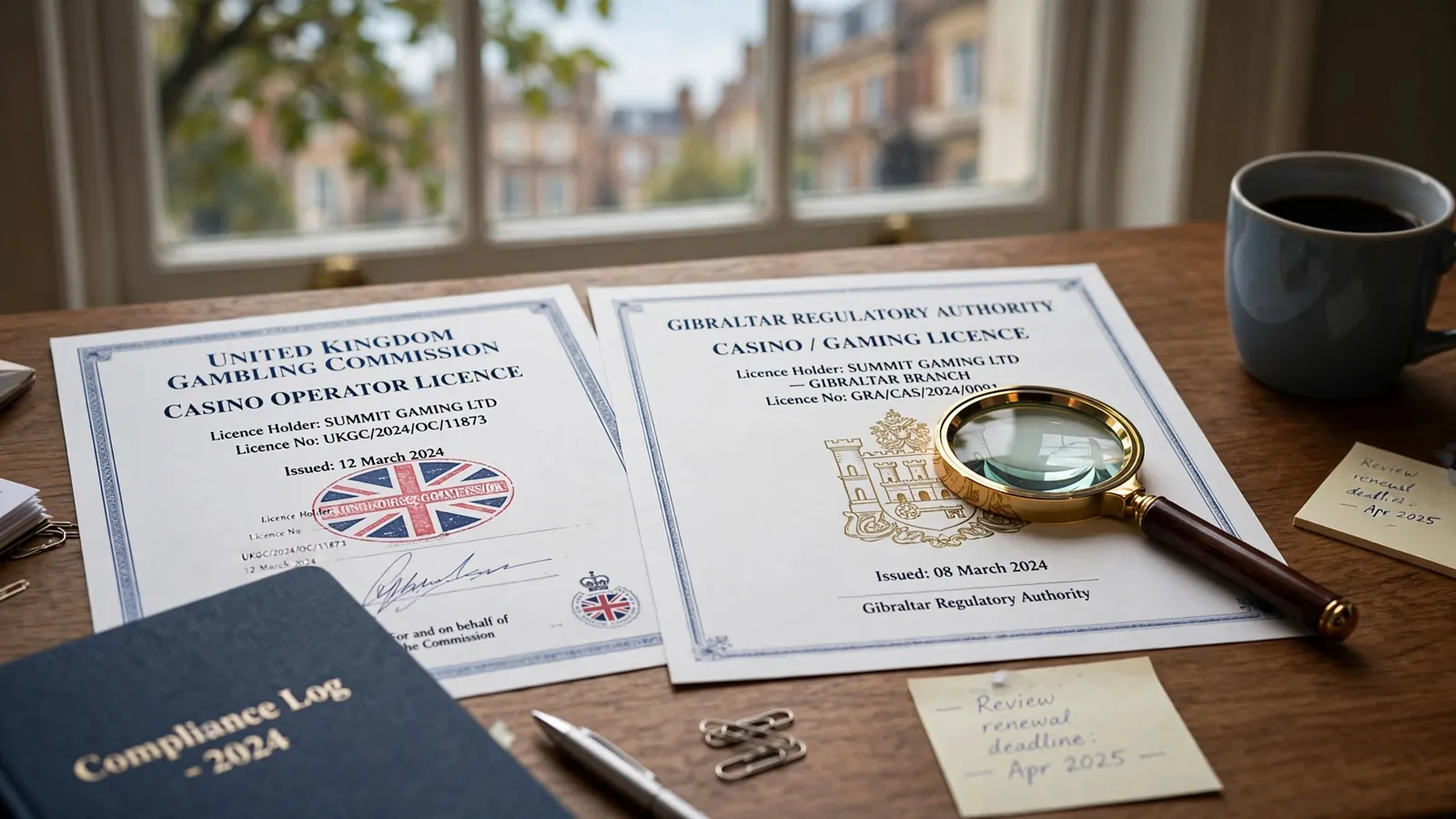
Table of Contents
- What a Gibraltar Casino Licence Does—and Doesn’t—Mean for UK Players
- Gibraltar-Licensed, UK-Regulated, or Neither? Read the Licence Claim Carefully
- Why an Online Casino’s Base Is Not the Same as Its UK Permission
- Gibraltar Casino Sites: Check the UKGC Position Before You Deposit
- “Best” Gibraltar Casinos: What the Label Can’t Prove
- “Top” Gibraltar Casino Sites in 2026: Don’t Mistake Freshness for Safety
- Real-Money Play: Payments and Withdrawals Can Be Less Predictable
- “Online Casino Gibraltar”: The Legal Question Is About the Operator
- New Gibraltar Casino Sites: Read the Terms Before the Welcome Offer
- Gibraltar and Other Offshore Licences: Don’t Assume the Safeguards Match
What a Gibraltar Casino Licence Does—and Doesn’t—Mean for UK Players
A casino’s Gibraltar connection and its permission to serve customers in Great Britain are two different things. I used to treat a licence from a familiar-sounding place as a kind of general passport. It isn’t. A Gibraltar casino licence is not a UK Gambling Commission licence, and it does not, by itself, authorise an operator to offer gambling to people in Great Britain.
The rule for businesses serving this market is tied to the customers they serve, not simply to the address on the company paperwork. An operator that supplies gambling services to customers in Great Britain must hold the relevant licence from the UK Gambling Commission, even if the business is based in Gibraltar or somewhere else. A Gibraltar address can tell you something about a company’s location. It cannot replace the UK permission required for its British-facing service.
That distinction matters because “Gibraltar casino” can describe several things: where an operator is based, which authority has licensed it, or simply how a site presents itself. Those descriptions may overlap, but they are not interchangeable. The important point for a customer in Great Britain is whether the operator has the UK licence required to serve this market. A licence issued elsewhere does not turn into one issued by the Commission.
There is a separate point about the player’s position. UK law does not expressly make it an offence for a British citizen to use a gambling service licensed in another country. That does not mean the operator has permission to target or serve customers in Great Britain without the required UK licence. The legal obligation on the business and the question of whether an individual player commits an offence are not the same question.

I find that easy to lose sight of when a site looks polished and its Gibraltar connection is displayed prominently. The place name can feel reassuring, but it answers only part of the story. It does not establish that the site is authorised for the British market, nor should it be read as a substitute for UK regulation.
So, if you see a Gibraltar online casino promoted to people here, keep the two ideas separate: its Gibraltar connection may be real, while its right to serve customers in Great Britain is a different matter. Don’t let one label do the work of the other. A local-sounding licence is not a UK licence.
Gibraltar-Licensed, UK-Regulated, or Neither? Read the Licence Claim Carefully
“Licensed” sounds reassuring, but it leaves out the part I now look for first: licensed by whom? A casino can hold permission from one jurisdiction and still have no oversight from the UK Gambling Commission. Those are separate claims, not two ways of saying the same thing.
A Gibraltar casino licence points to a regulatory connection with Gibraltar. It does not, by itself, tell you that the operator is regulated in the UK. Non-UK-regulated casinos may hold licences from jurisdictions including Gibraltar, Malta, Curaçao or Anjouan; the location named in the licence claim is not a substitute for the name of the regulator overseeing the operator in the UK.

That distinction is easy to miss when a site uses broad wording such as “fully licensed” or “regulated casino”. The phrase may be true in the limited sense that an authority outside the UK has issued a licence. It still does not establish UK Gambling Commission oversight. I used to read the word “regulated” as if it described one shared standard. It doesn’t tell you that on its own.
A useful way to parse the wording is to separate three ideas:
- Licensed: the operator says it has permission from a named jurisdiction or authority.
- Regulated in the UK: the operator is overseen by the UK Gambling Commission.
- Neither: the site has no relevant licence or oversight established by the claim you are reading.
The first description does not automatically prove the second. Nor does a polished badge or a line in a footer explain what the licence covers. If the wording names Gibraltar, take it as a Gibraltar-related claim—not as a quiet promise that the UK regulator supervises the site.
There is a difference between a statement about a company’s licence and a statement about a player’s protections. A licence claim tells you where the operator says its authority comes from. “UK-regulated” makes a different assertion about oversight. If those words are blended together, the reader can end up with a stronger impression than the wording actually supports.
I’m wary of treating a jurisdiction name as a quality score, too. Seeing “Gibraltar” may sound more familiar or official than an unnamed badge, but familiarity does not make it a UK Gambling Commission licence. The claim needs to be read for exactly what it says, not for the reassurance you hope it carries.
- Check for UK Gambling Commission oversight
- Distinguish between a licence and UK regulation
- Read licence claims for exactly what they say
- Treat a jurisdiction name as a quality score
- Assume “fully licensed” means UK regulated
- View a Gibraltar licence as a UK licence substitute
So when you see “Gibraltar-licensed” beside an online casino, keep the two labels mentally apart: a Gibraltar casino licence is one thing; UK regulation is another. The words can sit next to each other in advertising, but one does not prove the other.
Small distinction. Big one.
Why an Online Casino’s Base Is Not the Same as Its UK Permission
A casino’s address tells you where its business is based. It does not, by itself, tell you whether that business may offer gambling to customers in Britain. I used to treat a foreign base as if it answered the whole question. It doesn’t.
That distinction matters when you see claims about Gibraltar-regulated online casinos. Gibraltar may be relevant to where an operator is established, but the location alone does not settle what rules apply when it supplies gambling services to people in the UK. The focus of the Gambling Act 2005 is the operator’s activity in the market: it targets businesses supplying gambling services into the UK, rather than individual players.
So “based in Gibraltar” and “permitted to serve British customers” are not interchangeable descriptions. The same goes for regulated online casinos in Gibraltar: the wording may refer to regulation connected with the operator’s base, but it cannot automatically be read as permission for the UK market. A company’s location and the market it serves are separate questions.


Why are online casinos based in Gibraltar? The phrase can prompt guesses about tax, business costs or access to particular customers. But the fact of an operator’s base does not prove its reason for choosing it, and it does not establish what protections apply to a player in Britain. Don’t let a plausible explanation do the work of checking the actual position.
There is an important distinction for players, too. Under UK law, a person who gambles on an unlicensed site does not commit a criminal offence. That does not turn the site into a legally authorised UK service, or make the operator’s responsibilities disappear. The law’s focus is on the business supplying the service.
This is where the wording can muddy things. “International”, “Gibraltar-based” and “available to UK players” describe different things. Availability is not the same as permission. And a player not committing a criminal offence is not the same as having the protections that come with a properly authorised UK gambling service.
Two separate questions.
Gibraltar Casino Sites: Check the UKGC Position Before You Deposit
A site can present itself as connected to Gibraltar and still leave an important question unanswered: is it authorised to serve customers in Great Britain? Before putting money into an account, I’d check the operator’s UK Gambling Commission status directly. A Gibraltar address, a flag in the footer or a polished page about regulation does not settle that.
Verify UKGC Status
Access the UK Gambling Commission’s public register to find the business operating the site.
Ensure the operator’s entry specifically covers the relevant remote gambling activity.
Compare the registered company name with the legal details found in the site’s terms and conditions.
Start with the UKGC’s public register, rather than relying on a badge or a link selected by the casino. Look for the business operating the site and confirm that its entry covers the relevant remote gambling activity. Then compare the registered company name with the legal details on the site’s terms and conditions. If the names differ, or you cannot work out which company runs the account you are about to open, pause. It is hard to know who is responsible when the basic identity is unclear.
I’ve learned not to treat a licence logo as a shortcut. Follow the site’s own link to the regulator, and check that it takes you to an official record rather than another page controlled by the operator. A claim that a company has a Gibraltar connection is not the same thing as evidence of current UKGC permission. For a customer in Great Britain, the relevant point is whether the operator has the required UK licence.
Check who runs the account
The brand name on the home page may not be the legal name in the small print. Read the terms, privacy information and account rules to identify the company responsible for your account. The name should make sense alongside the UKGC record. If the site gives you no clear way to match the two, don’t fill the gap with assumptions.
Also check that the information is about the site you are actually using. A group may operate several brands, but a licence claim about one company or product does not automatically confirm the status of another. Keep the page address and company details in view while checking; a familiar logo is not a substitute for a matching entry.

This is the unglamorous bit. It matters.
See what the protections actually cover
A UKGC-regulated operator must work within the British system, including its mandatory responsible-gambling tools. That is not a promise that every dispute will go your way, but it is a meaningful difference from using a non-UK-regulated casino. At the latter, you do not have access to the UK’s Financial Ombudsman Service or the mandatory responsible-gambling tools that apply to UKGC-licensed operators.
Check the self-exclusion point before you create an account, especially if you rely on GamStop. Casinos outside that scheme do not participate in it, so registering with GamStop does not block access to them. That distinction is easy to miss when a site talks broadly about account controls or responsible play. Look for what the operator actually provides, and don’t assume a tool on one site applies across unrelated sites.
The standard of responsible-gambling and data-protection rules can also be less demanding outside UKGC oversight. Read the privacy information and account controls with that in mind; a reassuring phrase on a landing page does not show what happens to your data or what help is available if you need to limit gambling. If you cannot find plain answers, that uncertainty is part of the decision.
One more basic check: operators must verify a customer’s age before allowing deposits. If the site appears to let you fund an account without that verification, don’t treat it as a harmless shortcut.
You do not need to decide from a headline, a Gibraltar connection or a row of badges. Establish the operator’s identity, verify its UKGC position through the official register, and understand which protections apply before depositing. If any of those points remain muddled, leave the money where it is.
Verification Steps
- Confirm the operator’s identity through terms and conditions
- Verify the UKGC position using the official public register
- Check for participation in the GamStop scheme
- Ensure age verification is required before depositing
“Best” Gibraltar Casinos: What the Label Can’t Prove
“Best” sounds like a verdict. On a casino page, it is usually a sales word: it tells you how the site wants to be seen, not which regulator stands behind it or what help you can use if a dispute goes badly. I used to give these labels more weight than they deserved. A polished page can make a recommendation feel researched without answering the questions that matter once money is involved.
That applies whether you are weighing up a casino site connected with Gibraltar or reading a list of supposed favourites. “Best online casinos in Gibraltar” can mean casinos aimed at people who live there, sites based there, or sites with some Gibraltar connection. It does not, by itself, tell you what protections apply to a customer in Great Britain. The wording can blur those distinctions neatly. Convenient for the advert. Less convenient for you.

A non-UK-regulated casino operates without supervision from the UK Gambling Commission. That is the point to keep in view when an enthusiastic review calls a site one of the best. A foreign licence and a glowing rating do not add up to UKGC oversight. Nor does a high position on a page prove that you can use the UK’s usual routes for help if the operator and you disagree.
What a superlative leaves out
When I see “best casino sites” beside a prominent bonus or a row of attractive game images, I try to separate presentation from protection. The label may reflect an editor’s view, an advertising relationship, or criteria that are never made clear. Even a sincere recommendation cannot turn an overseas regulator into the UK Gambling Commission, or promise that the same player safeguards apply.
The practical difference matters. If you use an offshore casino, you forfeit access to the UK’s Financial Ombudsman Service and to the mandatory responsible-gambling tools that come with the UK framework. That is not a small detail to tuck below a star rating. It changes what support and controls you can rely on if you need to challenge a decision or manage your play.

I would not read that as proof that every non-UK-regulated operator behaves badly. It is a reason not to treat a superlative as a substitute for independent protection. A site can look orderly, respond quickly at first, and still leave you with fewer formal options if something later goes wrong. Nice design. Different safety net.
This is why “best online casino Gibraltar” is not a useful conclusion on its own. The phrase could be describing a casino’s location, its licence claim, or simply the audience the page hopes to attract. Those are not interchangeable. A ranking cannot settle what a licence authorises, and praise from a review page cannot make UK protections available where they do not apply.
Read the recommendation with scepticism
I look for the reasoning behind the word, rather than the word itself. Does the page explain what its rating measures? Does it distinguish a Gibraltar connection from UK regulation? Does it say plainly when a casino is outside UKGC oversight and what that means for complaints and safer-gambling controls? If those points are missing, the ranking is asking you to trust its tone.
Attention: A high ranking or “best” label does not guarantee UKGC oversight or the availability of the UK’s Financial Ombudsman Service.
“Best online slots” is another phrase that can distract from the operator question. A catalogue of games, however appealing, says nothing by itself about who regulates the casino or which protections you can access as a UK customer. The game list and the safeguards belong in separate mental boxes. I have blurred them before; it is an easy mistake when the page is designed to keep your attention on the offer.
Nor does adding the current year to a “best” label make the recommendation more reliable. It may make the page look recently refreshed, but freshness is not the same as evidence about regulation or player support. That question deserves more weight than a badge, a ranking position, or a confident line about being a leading Gibraltar casino.
I still understand the appeal of a shortcut. Comparing sites takes effort, and a ranked list promises to do the thinking for you. But when the label does not explain the limits of the protection on offer, it has skipped the part I most need to know. Call it “best” if you like. I still want the regulator and the safety net.
“Top” Gibraltar Casino Sites in 2026: Don’t Mistake Freshness for Safety
If you’re looking at Gibraltar casino licensing in the UK for 2026, check each operator’s current licensing and UK availability before choosing. The details provided here offer one practical point to consider: stated payout speed.
Payout speed: 1-3 business days x3bet lists a payout speed of 1–3 business days. If payout timing matters to you, use that as a point to check against the operator’s current terms.
Payout speed: 1-3 business days NightWin lists a payout speed of 1–3 business days. Check the current terms to understand how that timing applies to your withdrawal.
Payout speed: 1-3 business days Amunbet lists a payout speed of 1–3 business days. This gives you a stated timeframe to consider when reviewing its withdrawal terms.
Payout speed: 1-3 business days WinBeast lists a payout speed of 1–3 business days. You can use this stated timeframe as one factor when assessing the operator.
Payout speed: 1-3 business days Jetsetspins lists a payout speed of 1–3 business days. Check its current terms for details about how the stated timeframe applies.
Payout speed: 1-3 business days Chanze lists a payout speed of 1–3 business days. If you’re considering it, review the current withdrawal terms alongside this stated timing.
Payout speed: 1-3 business days EvoSpin lists a payout speed of 1–3 business days. That stated timeframe may help you assess whether its payout timing suits your needs.
Payout speed: 1-3 business days SpinFormula lists a payout speed of 1–3 business days. Refer to its current terms for further details about withdrawals.
Payout speed: 1-3 business days Dieselwin lists a payout speed of 1–3 business days. You can factor this stated timing into your review of the operator.
Payout speed: 1-3 business days Revery Play lists a payout speed of 1–3 business days. Check the current terms to confirm how this timeframe applies to withdrawals.
A page labelled “top Gibraltar casino sites in 2026” can look reassuringly current. I’ve been tempted by that sort of stamp myself: a fresh date, polished wording and a confident verdict can make a page feel as if someone has checked the important details. But a recent-looking label tells you when the page claims to have been updated, not whether a casino is permitted to serve customers in Great Britain or what protections apply if something goes wrong.
That distinction matters more than a ranking. Operators serving Great Britain need a UK Gambling Commission licence, wherever their business is based. A Gibraltar connection, or a place near the top of a current list, does not replace that permission. “Top” is a judgement made by whoever published the page; it is not a regulatory status.
The same goes for a “2026” badge. It might mean the page was revisited, or simply that the year appears in its heading. Neither tells you that the information has been checked against the operator’s current position. I would not treat a new date as evidence of safety. It’s just a date.
There is another reason not to confuse freshness with protection. Non-UK-regulated casinos may apply less demanding standards to responsible gambling and data protection than operators overseen by the UKGC. That can affect how much confidence you have in the safeguards around play and personal information. A lively interface or a long list of features cannot answer those questions for you.
I used to read a “top” label as if it meant somebody had already done the hard thinking. In practice, it can tell you very little about the basis for the selection. Perhaps the page is built around popularity, perhaps commercial arrangements, perhaps a mix of things. Without a clear explanation, the ranking itself is not proof of suitability for a British customer.
Non-UK-regulated casinos may apply less demanding standards to responsible gambling and data protection than those overseen by the UKGC.
So when a result presents a Gibraltar casino as one of the leading choices this year, pause before letting the wording do the deciding. The key issue is not whether a site looks new or appears in a current list; it is whether the operator has the permission required to serve Great Britain and what safeguards apply to you. A “top” label can’t settle either point.
This is not me saying that every page with a recent date is worthless. It is me saying that dates and superlatives are easy to display, while meaningful oversight is a separate matter. I’ve learned not to let the neatest badge answer a question it was never designed to answer. Fresh page. Different question.
Real-Money Play: Payments and Withdrawals Can Be Less Predictable
When I’m looking at real-money play connected with Gibraltar, I try not to treat the cashier as a promise. A site may show credit cards, e-wallets, bank transfers or cryptocurrencies as deposit options, sometimes handled through alternative processors. That tells you what it may accept when money goes in. It does not prove the same route will be available when you try to take money out.
That distinction is easy to miss. I’ve seen a familiar-looking payment logo and assumed the rest would be straightforward. It wasn’t a safe assumption. A non-UK-regulated casino can have different payment arrangements for deposits and withdrawals, and the route offered to you may depend on the method and the operator’s process. Check the withdrawal terms themselves before paying in; don’t infer them from the deposit page.
Timing is just as uncertain. Some descriptions put withdrawals at non-GamStop casinos at between 24 hours and five business days, depending on the payment method. Other accounts of non-UK-regulated casinos warn that a withdrawal can stretch to three or four weeks. Those accounts disagree, so neither the quicker estimate nor the longer one should be treated as a dependable promise for a particular site.

There is another practical difference: with a non-UK-regulated casino, there is no UK regulatory clock to enforce a payout deadline. If a payment is delayed, you may have to deal with the operator’s own support process rather than rely on a UK regulator to make it meet a UK-set timetable. That doesn’t mean every withdrawal will be slow. It means the advertised speed is not the whole story. A neat figure on a cashier page is not the same as a reliable outcome.
Before depositing, I’d read the rules for the exact payment method I intend to use. Look for whether withdrawals must go through a particular route, what verification the operator can request, and how it describes processing time. Save the terms and any confirmation of the transaction. If the explanation is vague, or the available withdrawal information doesn’t match the deposit options, pause. It’s easier to decide before your money is sitting in an account.
The same goes for real-money slots: a balance shown on screen is not money in your bank account. A payment method that works for a deposit may not be available for a withdrawal, and a stated processing window may not cover every stage of the operator’s checks or the payment provider’s handling. Don’t build a spending decision around the fastest account you have read.
I used to focus on how quickly I could get started. Now I pay more attention to how clearly the site explains getting out. For Gibraltar-associated real-money casinos, the payment list may look broad, but the useful question is whether the withdrawal route and timing are explained in plain terms. If they aren’t, I assume uncertainty—not speed.
Payment Risks
With non-UK-regulated casinos, there is no UK regulatory clock to enforce payout deadlines, and withdrawal routes may differ from deposit methods.
“Online Casino Gibraltar”: The Legal Question Is About the Operator
A Gibraltar connection can sound like an answer in itself. I used to read a place name beside a casino and assume it told me where the site could do business. It doesn’t. The useful question is whether the operator is authorised to serve customers in Great Britain, not simply whether the business has a Gibraltar address or licence.
The Gambling Act 2005 puts the legal obligation on the business supplying gambling services into the British market. An operator serving customers in Great Britain needs the relevant UK Gambling Commission licence, wherever it is based. So a casino being licensed elsewhere does not, by itself, give it permission to offer gambling here.
That distinction matters when you’re weighing what the law says about the operator against what it says about you. The Act targets operators supplying services to the UK market; it does not make the individual player the party committing the offence. British citizens are not expressly barred by UK law from using gambling services licensed in another country, and a player who gambles on an unlicensed site does not commit a criminal offence under UK law.
That is a narrow point about personal criminal liability. It is not the same as saying that an unlicensed site is legally authorised to serve Great Britain, or that using it gives you the protections attached to a UK-regulated service. Those are different questions, and blending them together is how a reassuring-sounding licence claim can do too much work.

When I see a Gibraltar-based online casino described as “available to UK players”, I don’t treat that wording as proof of permission. It may describe who can access the site, rather than settle whether the operator is entitled to supply gambling services in Great Britain. Access and authorisation are not interchangeable.
There’s no need to turn this into a judgement about the player. The legal distinction is simpler: the operator’s obligations concern the market it serves, while the stated absence of a criminal offence for the player does not confer UK authorisation on the site. I’d keep those two points separate before deciding what a licence label actually means.
The location is not the permission.
New Gibraltar Casino Sites: Read the Terms Before the Welcome Offer
A new casino can make its welcome offer look like free money. I used to focus on the headline and leave the small print for later. That is backwards: the terms tell you what you would actually have to do before any bonus-related winnings could be withdrawn.
Start with the wagering requirement. It may apply to the bonus, your deposit, or both, and those are very different conditions. A specialist review has reported offshore welcome offers with requirements of 35x or more; treat that as a reported example, not a rule for every Gibraltar-associated site. Check what the multiplier applies to and which games count. If the wording is vague, you cannot sensibly estimate how much play the offer demands.
Evaluate Welcome Offers
- Check if wagering requirements apply to the bonus, deposit, or both
- Identify which games contribute toward the wagering multiplier
- Verify the expiry period for free spins
- Check for maximum withdrawal caps on bonus winnings
Free spins deserve their own check. The spins may expire before you have a realistic chance to use them, and any winnings can come with a separate wagering condition. A specialist review has reported free-spin winnings subject to wagering of 30–50 times the winnings, alongside withdrawal caps of £5–£50. Those figures describe terms reported in that review, not a promise that a particular new casino uses them. Find the offer’s own rules and check whether a cap applies to the winnings, the bonus, or both.
Expiry is easy to miss. A specialist review has reported free-spin packages with expiry periods of 24–72 hours. The operator’s terms are what matter for the offer in front of you, so look for when the clock starts and what happens to unused spins. A generous-looking bundle is less useful if it disappears before you can play.
I now read the bonus rules before registering, not after a banner has got me interested. Check whether the offer is optional, whether accepting it changes withdrawal conditions, and whether the promotion can be amended. Keep a copy of the terms shown when you opt in; a welcome offer is not a settled deal just because its headline is still on screen.
New Gibraltar casino sites may be eager to advertise a first-deposit package, but “new” tells you nothing about how workable its conditions are. Read the detail, decide whether you would play without the bonus, and skip it if the rules do not make sense. No offer is worth guessing.
Gibraltar and Other Offshore Licences: Don’t Assume the Safeguards Match
I used to read a licence badge as if it were a ready-made safety rating. It isn’t. A regulator’s name tells you which framework may apply; it does not, by itself, tell you how player funds are treated or where a complaint can go. And a Gibraltar connection should not be treated as proof that rules from another jurisdiction apply.

Anjouan is a useful example of why the distinction matters, not a template for every offshore licence. Under its framework, casinos are not required to keep player funds separate from company funds, and the framework does not mandate independent game testing, audits or segregated funds. If an operator fails, players may be unsecured creditors rather than having protected funds set aside for them. That is specific to the Anjouan framework; it should not be casually attributed to Gibraltar.
The complaint route is another concrete difference. The Anjouan authority does not investigate or decide individual player complaints, and an Anjouan-licensed casino does not provide an independent dispute-resolution route comparable to one approved under the UK Gambling Commission system. The framework requires operators to respond to complaints within 30 calendar days, but an operator response is not the same thing as independent adjudication. That distinction can matter when a dispute is about a balance or a changed term.

With a Gibraltar-linked business, I would want to know which company actually holds the licence, which regulator issued it, and what complaints process applies to that particular operator. Then I’d look for clear information about player funds, game testing and audits. If those details are vague, the licence label alone does not fill the gaps. I wouldn’t assume Gibraltar offers Anjouan’s protections—or Anjouan’s shortcomings—without checking the applicable rules and the operator’s own arrangements.
The UKGC framework is a separate point of comparison, not a guarantee that every licensed site is flawless. Its regulated operators work within British requirements, including access to approved alternative dispute resolution for eligible complaints. A non-UK-regulated casino does not give you that UKGC route just because it has a licence elsewhere. The regulator and the complaint pathway need to match the service you are using.
So when a site describes itself as part of Gibraltar’s online gambling industry, I’d treat that as a starting detail, not a verdict. The same goes for claims about new or “top” casinos: fresh branding and a confident badge do not tell you whether funds are ring-fenced or who can review a dispute. Different jurisdictions, different rules. Check the actual licence and complaint route, and don’t assume safeguards match simply because both sites call themselves licensed.
What payment methods work best at non-UK-regulated casino sites?
You may find credit cards, e-wallets, bank transfers and cryptocurrencies accepted, sometimes through alternative processors. Some sites also allow payments through a mobile phone bill or prepaid balance; withdrawal speed depends on the method.
What happens if I have a dispute with an Anjouan-licensed casino as a UK player?
You can complain to the operator, which must respond within 30 calendar days, but Anjouan does not handle or adjudicate player complaints. You also do not get an independent dispute-resolution route comparable to UKGC-approved ADR.
What are non-UK-regulated casinos?
They are online gambling sites that operate without oversight from the UK Gambling Commission. They may be licensed in places such as Gibraltar, Malta, Curaçao or Anjouan, but that does not make them UK-regulated.
What payment options are available at non-UK casinos?
You may be able to pay by credit card, e-wallet, bank transfer or cryptocurrency, often through alternative processors. Some sites also accept payments charged to a mobile phone bill or deducted from a prepaid balance.
What is the biggest risk of playing at a non-UK-regulated casino?
You have fewer protections if something goes wrong: you do not have access to the UK’s Financial Ombudsman Service or mandatory responsible-gambling tools. At Anjouan-licensed casinos, player funds are not guaranteed to be segregated, so you may be an unsecured creditor if the operator fails.
Are gaming sites not on GamStop permitted for UK players?
UK law does not explicitly prohibit you from using a gambling service licensed in another country. However, operators serving customers in Great Britain must hold a UK Gambling Commission licence, and sites not on GamStop are outside the Commission’s self-exclusion scheme.
Published by the Tenobet Casino 2 team.