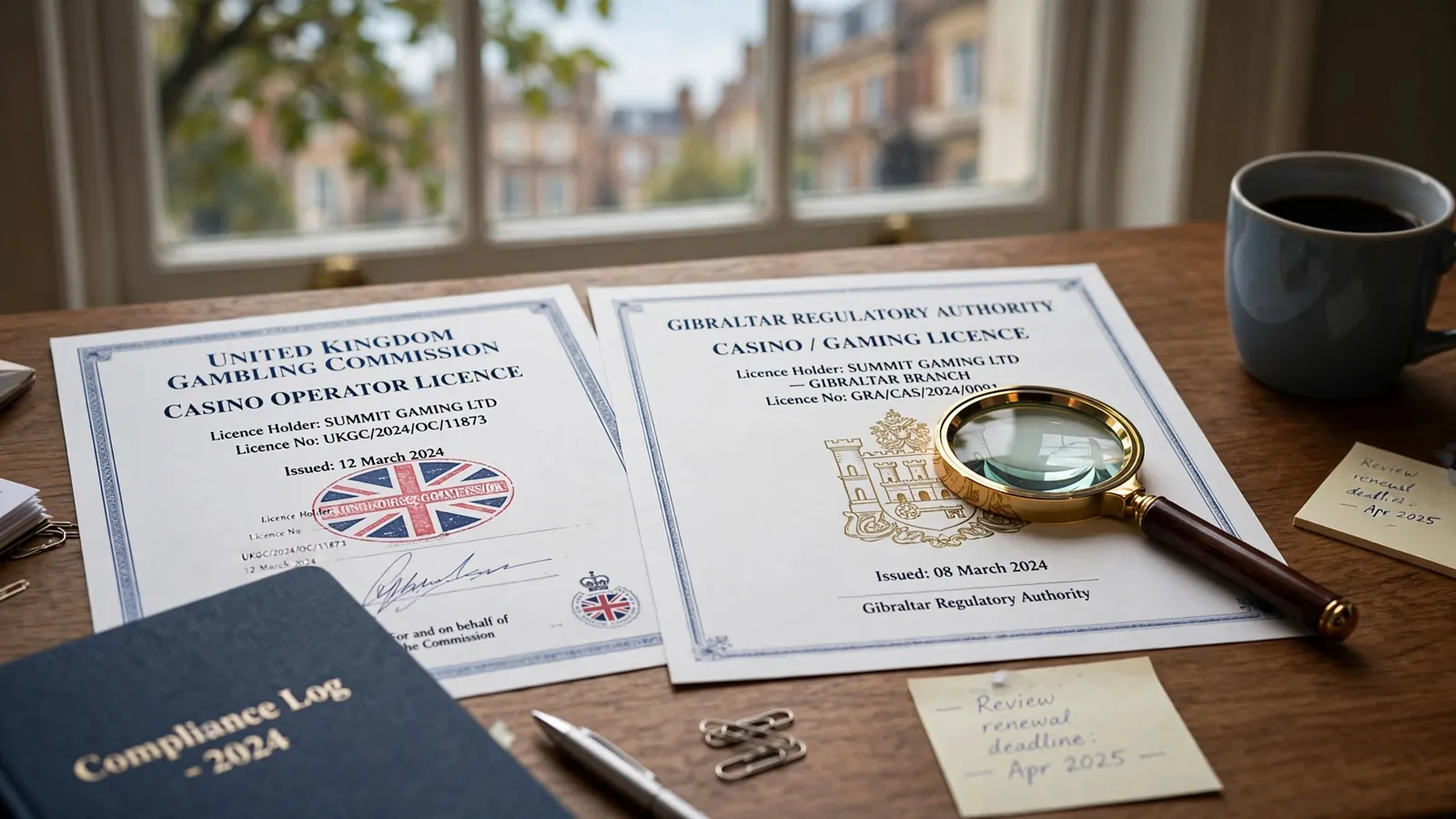
Casinos Without a Swedish Licence: UK Rules Explained
 Available in GB
A Swedish or other overseas licence is separate from UKGC approval, with different rules, safeguards and payment conditions.

Table of Contents
- What “Without a UK Licence” Actually Means
- Non-GamStop Casinos: What the Name Leaves Out
- A Swedish Licence Search in 2026: Check the Licence Behind the Label
- Outside UKGC Regulation: The Protection You Give Up
- Bonuses, Free Spins and the Terms That Can Swallow Them
- Non-UK Casinos May Have Different Rules—and Different Risks
- New Offshore Casinos: Expect Checks and Possible Delays
- Playing from the UK Means Checking the Trade-Offs Yourself
- Overseas Casino Payments: More Options, No Automatic Cash-Out
- Anjouan Casinos Outside UKGC Oversight: What the Licence Does Not Promise
What “Without a UK Licence” Actually Means
When I first saw a casino described as “without a UK licence”, I read it as a warning about the person playing there. That is not what the phrase means. It describes the operator: the site is running without oversight from the UK Gambling Commission (UKGC). The distinction matters. A casino’s regulatory status and a player’s legal position are two separate things.
For operators serving customers in Great Britain, the rule is straightforward: they need a UKGC licence, wherever the business itself is based. A company does not avoid that requirement by operating from another country or holding permission from a regulator there. If it supplies gambling services into the British market without the required UK licence, it is outside the UK regulatory system.
That does not mean every overseas-licensed casino has the same status or operates under the same rules. A licence issued by another jurisdiction is a separate authorisation, not a UKGC licence by another name. It may tell you something about the operator’s position in that jurisdiction, but it does not establish that the casino is authorised to serve customers in Great Britain. Nor does the phrase “international casino” settle the question. The relevant point is whether the operator holds the licence required for the market it is serving.
If you’re considering a casino without a Swedish licence in 2026, check the available details carefully before deciding whether it suits you. This reference highlights the one confirmed detail available for each operator.
Payout speed: 1-3 business days You can expect payouts in 1–3 business days.
Payout speed: 1-3 business days You can expect payouts in 1–3 business days.
Payout speed: 1-3 business days You can expect payouts in 1–3 business days.
Payout speed: 1-3 business days You can expect payouts in 1–3 business days.
Payout speed: 1-3 business days You can expect payouts in 1–3 business days.
Payout speed: 1-3 business days You can expect payouts in 1–3 business days.
Payout speed: 1-3 business days You can expect payouts in 1–3 business days.
Payout speed: 1-3 business days You can expect payouts in 1–3 business days.
Payout speed: 1-3 business days You can expect payouts in 1–3 business days.
Payout speed: 1-3 business days You can expect payouts in 1–3 business days.
There is a legal distinction here that can get lost in blunt warnings. The Gambling Act 2005 is directed at operators who provide gambling services into the UK market; it does not make the individual player its target in the same way. UK law does not expressly forbid British citizens from using gambling services licensed abroad, and playing on an unlicensed site is not, by itself, a criminal offence for the player.
That is not the same as saying an unlicensed site is legal to serve British customers. The operator’s obligation and the player’s position are not interchangeable. An operator can be outside the rules that apply to services offered in Great Britain, while the person using the site does not thereby commit a criminal offence. I used to flatten those two points into one and assume that if a site existed, it must be permitted to take my play. That was a bad shortcut.
It also helps to be precise about geography. The UKGC licensing rule described here applies to operators serving Great Britain. The Gambling Act 2005 covers England, Wales and Scotland, but not Northern Ireland, so “UK licence” can be a convenient phrase that obscures a more specific legal picture. If you are deciding what applies to you, do not assume that a statement about Great Britain automatically answers every question for every part of the UK.

The words “without a UK licence” can also sound as though the casino has no licence at all. That may not be true. It might hold a licence in another jurisdiction; it might not. Either way, an overseas licence does not replace the UKGC authorisation required for an operator serving Great Britain. The label alone cannot tell you where the operator is licensed, what that licence covers, or whether the site is entitled to serve customers in the market you are in.
I now separate the question into two parts. First: what is the operator’s regulatory position, and does it hold the UKGC licence required to serve customers in Great Britain? Second: what does the law say about the individual who uses the site? The first concerns the operator’s permission and oversight. The second concerns the player’s liability. Mixing them up leads to claims that are more dramatic than the legal position supports.
So, if you come across an online casino described as operating without a UK Gambling Commission licence, read that as a statement about regulation, not as proof that the player is committing a crime. But do not flip that around and treat the absence of a player offence as approval of the operator. Those are different claims. One does not cancel out the other.
Attention: A casino operating without a UKGC licence is outside the UK regulatory system, regardless of whether it holds a licence in another jurisdiction.
The plain version is this: a non-UK-regulated casino operates outside UKGC oversight, and an overseas licence does not meet the British licensing requirement for operators serving Great Britain. British players are not criminally liable simply for gambling on an unlicensed site, but that fact does not make the site UK-licensed or establish that it may lawfully offer services in Great Britain. Two different positions. Keep them separate.
Non-GamStop Casinos: What the Name Leaves Out
“Not on GamStop” sounds like a neat description of a casino. It is really a description of one specific thing: the site is outside GamStop, the UK Gambling Commission’s self-exclusion scheme. That distinction matters most if you have used GamStop because you wanted to put distance between yourself and gambling.
The phrase does not mean that GamStop has checked the site and decided it is suitable for you. Nor does it mean that the scheme can block you from opening it. A casino outside GamStop is simply not part of that self-exclusion system. The label tells you where the site sits in relation to GamStop; it does not tell you that your self-exclusion will carry across.
I used to read labels as if they were little safety summaries. They aren’t. “Non-GamStop” can sound like a feature, especially when a site presents it as a way to get back in and play. But for someone who has chosen self-exclusion, that same fact can mean the barrier they set up will not do the job they expect on that site. That is the part worth taking seriously.

What self-exclusion does—and does not do here
GamStop is a self-exclusion scheme. Casinos not on GamStop do not participate in it, so you should not assume that registering with GamStop will prevent access to those casinos. The scheme’s reach does not magically extend to every gambling website just because you are in the UK or because a site advertises itself to UK players.
That leaves the decision with you at the moment you encounter the site. If you joined GamStop to stop yourself gambling, finding a casino outside the scheme is not evidence that your original reason has gone away. It may instead be a sign that you are looking for a route around a boundary you deliberately set. I know how easy it is to tell yourself that this time is different. It may feel like a small exception. It isn’t necessarily small.
The wording can also blur two separate ideas: being outside GamStop and having safeguards comparable to those you expect from a UK-regulated site. They are not the same thing. The fact that a casino is not included in GamStop does not mean it offers an alternative self-exclusion arrangement with the same reach or effect. Don’t infer a safety feature from a label that only describes absence from one scheme.
The name is not a safety rating
Searches for a casino not on GamStop often mix together very different expectations. Some people want to know whether a particular site will recognise their GamStop status; others may be trying to find a place to gamble after self-excluding. The label alone cannot answer every question about how an operator handles a request to stop gambling. It also cannot show you whether any tools on that site are mandatory, how they work, or whether they would be enough for your situation.
Self-Exclusion Risk
If you have joined GamStop to stop gambling, be aware that casinos outside the scheme will not block your access, potentially weakening the boundaries you deliberately set.
That is why I would not treat “best” in a description of non-GamStop casinos as a useful measure of protection. A site can use friendly language around responsible gambling without being part of GamStop. A button or a promise on a website is not the same as the external scheme you may have relied on. If you are already trying to stay away, comparing labels can become a way of negotiating with yourself. I’ve made that mistake. It does not make the risk disappear.
Playing at an offshore casino also means giving up access to mandatory responsible-gambling tools available through the UK system, and to the UK’s Financial Ombudsman Service. That is not a minor footnote if you expect a UK-style backstop. The point here is not that every site behaves identically; it is that you should not assume you retain those protections simply because the casino accepts you or uses familiar language.
If you have already self-excluded
If you joined GamStop because gambling was becoming difficult to control, the safest reading of “not on GamStop” is straightforward: the scheme may not stop you from reaching that site. Don’t mistake accessibility for permission from the scheme, or for a sign that gambling is a good idea for you now.
It may help to pause before creating an account or making a deposit, and to be honest about what you hoped GamStop would do. If you were relying on it to make gambling harder to reach, a site outside its coverage weakens that barrier. You do not need to prove that you can handle the exception. You can close the page and keep the boundary you chose.

I’m not saying that a label tells you everything about a casino. It doesn’t. I am saying that, on this point, it tells you something important: GamStop does not cover it. Treat that as a limitation, not a loophole.
A Swedish Licence Search in 2026: Check the Licence Behind the Label
A search for a casino without a Swedish licence can turn up sites carrying all sorts of licensing claims. That label may tell you something about the operator’s stated regulatory home, but it does not answer the question that matters if you are in Britain: whether the licence permits the site to serve customers here.
I used to treat a licence badge as a kind of general passport. It isn’t. A casino can name a regulator and still lack permission to operate in a particular market. The licence, the company behind the site and the countries where it is authorised to offer gambling are separate details. One label cannot settle all three.
For UK players, that distinction matters. Operators serving customers in Great Britain need a UK Gambling Commission licence, wherever the business itself is based. A licence from another jurisdiction is not a substitute for that authorisation. So a Swedish licence search, or a page describing a “casino without a UK licence”, should not lead you to assume that a foreign licence makes the site suitable or authorised for British customers.
For operators serving customers in Great Britain, holding a UKGC licence is a straightforward requirement, regardless of where the business is based.
What the label does—and does not—tell you
When I check a licensing claim, I look for the name of the legal operator, not just the casino brand. I then compare that company name and the licence details with the regulator’s own information, and check whether the claimed authorisation applies to the market I care about. If the site gives only a badge or a vague line about being “licensed internationally”, that leaves too much unanswered.
The same goes for terms such as “MGA casino” or “new casino”. A reference to a recognised regulator does not, by itself, establish that the operator holds the right licence for Great Britain. Nor does a recent launch tell you anything about where the casino may lawfully operate. A brand can look polished and still leave basic licensing details hard to pin down.
This is why lists of casinos without a UK licence can be misleading when they sort sites by a single label. They may describe a casino’s claimed licence, but that is not the same as confirming permission to serve UK customers. I would treat the label as a starting point for checking, not as a verdict. No badge does that work for you.
Anjouan as a practical example
Anjouan makes the distinction especially clear. An Anjouan casino licence does not authorise an operator to run a gambling service in the United Kingdom, or in other markets that are listed as restricted. Seeing that licence named on a casino site therefore does not establish that the casino may accept customers in Britain.

There is another reason not to stop at the licence name: the framework has gaps that affect what the label promises. It does not require casinos to have random number generators tested, to undergo audits, or to keep player funds in segregated accounts. In other words, the existence of an Anjouan licence does not confirm those safeguards are in place.
That point about funds is more than technical wording. Anjouan-licensed casinos do not guarantee that player money is kept separate from the operator’s own funds. If the operator fails, players are unsecured creditors. I would not read a licence badge as proof that a balance is protected from the business’s financial problems.
The complaints process has its own limits. Under Anjouan’s framework, an operator has to respond to a complaint within 30 calendar days, but the authority itself does not take up, mediate or decide player disputes. A response deadline is not the same thing as an independent body reviewing what happened. The framework also does not require an independent dispute service comparable to the approved routes available under UKGC regulation.
That distinction is easy to miss when a site says it has a “complaints procedure”. The phrase may refer to a conversation with the operator, not a route to an outside decision-maker. If a disagreement arises, it matters who actually handles it—and whether that body can adjudicate the issue.
Checking a Licence
Look for the name of the legal company running the site, not just the brand name.
Compare the company name and licence details with the information provided by the regulator’s own records.
Check whether the specific authorisation allows the operator to lawfully serve customers in the market you are in.
Read the detail, not the badge
For any casino claiming an overseas licence, check that the legal company named in the terms matches the entity shown in the regulator’s own records. Check the licence status and whether the authorisation covers the market you are considering. If those details do not line up, or the site does not make them clear, do not fill in the gaps with assumptions.
A Swedish licence search can point you towards casinos using different regulatory arrangements, but “without a Swedish licence” is not a useful shortcut for deciding whether a site is authorised in the UK. Likewise, a casino without a UKGC licence is not made suitable for British players simply by displaying a licence from elsewhere. The licence’s scope matters.
I’ve learned to distrust the comforting version of “licensed”: it can mean less than the badge suggests. Check who holds the licence, what it permits, and what the framework actually requires. Then judge the site on those details, not on the label alone.
Outside UKGC Regulation: The Protection You Give Up
The difference I pay attention to is not just the name on a licence. It is what happens when something goes wrong and which protections actually apply to your account. A non-UK-regulated casino may be subject to less demanding responsible-gambling and data-protection rules than a UK Gambling Commission-licensed operator. That does not prove every such site handles information badly or ignores player wellbeing. It does mean you should not assume the UK standard follows you there.

Responsible-gambling safeguards are one practical example. UK-licensed operators must provide mandatory tools; at a site outside that system, you may not have the same protections. A responsible-gambling page or a promise to “play safely” is not the same as a required tool that is available through the regulated framework. I used to treat reassuring wording as evidence. It isn’t. Check what controls the account actually offers, and don’t build a plan around a safeguard you have not confirmed is there.
Your personal information deserves the same scrutiny. You may give a casino identity and payment details, but the data-protection rules governing their handling can be less stringent than those applying to a UKGC-licensed operator. Before registering, read the privacy information: look for what data is collected, why it is used, and how the operator says it is protected. If those details are hard to find or written so vaguely that you cannot tell what happens to your information, take that uncertainty seriously. A polished site does not tell you how carefully your data is managed.
There is also a clear difference when you have a complaint. If a dispute concerns an offshore account, you cannot rely on the UK’s Financial Ombudsman Service as the route for resolving it. Nor should you expect the UK Gambling Commission to act as your complaints service for play with an operator outside its oversight. That can leave you dealing with the casino itself, under its own process, without the familiar UK route available to customers of regulated operators.
Protections Comparison
- Non-UKGC casinos may have less demanding responsible-gambling and data-protection rules.
- You lose access to mandatory UK-system responsible-gambling tools.
- The UK’s Financial Ombudsman Service cannot be used to resolve disputes with offshore operators.
That matters most when the disagreement is about something you cannot easily reverse: account access, a decision made by the operator, or the handling of your information. A support team may answer promptly, but a reply from the company is not independent oversight. I have learnt not to confuse “contact us” with “someone outside the company can review this”.
None of this tells you that every non-UKGC casino will treat customers poorly. It tells you that the protections are not interchangeable. Before handing over details or depositing, work out which safeguards you can actually use, what happens to your data, and where a complaint would go if the operator says no. If the answer depends on an assumption, count that as a risk—not as protection.
Bonuses, Free Spins and the Terms That Can Swallow Them
A welcome bonus looks simple until you open the terms. I’ve made the mistake of treating the headline offer as money I could actually use, rather than a conditional balance. With a no-deposit offer, the same check matters: “free” can still come with wagering rules, a deadline or a cap on what you can withdraw.
A specialist review I checked reported offshore welcome offers with wagering requirements of 35x or more. That is a reported example, not a rule for every casino or every promotion. The crucial detail is what the multiplier applies to. In one offer, a 40x requirement may be calculated on the bonus alone; in another, on the bonus and deposit together; and another may include bonus funds and free-spin winnings. Those bases produce very different totals.

Before opting in, find the exact calculation in the offer terms. If it is unclear whether the deposit counts, or whether free-spin winnings join the same wagering target, do not assume the smaller interpretation. The headline may say “welcome bonus”; the small print decides what you must wager before a withdrawal is allowed.
Free spins need their own check. A specialist review reported examples where winnings faced wagering requirements of 30–50 times the winnings, alongside withdrawal caps ranging from £5 to £50. Those figures describe reported offers, not a promise that every site uses the same terms. A cap can matter more than the spin count: even a good run may leave you unable to withdraw all the winnings under that promotion.
Expiry is another catch. One specialist review described free-spin packages expiring within 24–72 hours. Check when the clock starts and whether you need to activate or use the spins by then. If you miss the window, the offer may be gone; if you claim it without reading the rules, you may be left chasing a balance that is harder to release than it first appeared.
I now treat each bonus as a separate set of conditions, not as extra cash. Check the wagering base, eligible play, expiry and maximum withdrawal before accepting. If the terms do not explain those points plainly, walking away is a perfectly good outcome. No bonus is owed to you.
- Check the wagering base and multipliers
- Verify eligible play and expiry dates
- Review maximum withdrawal caps
- Treat headline offers as guaranteed cash
- Assume free spins have no wagering rules
- Ignore the small print before opting in
Non-UK Casinos May Have Different Rules—and Different Risks
When I first looked beyond UK-regulated sites, I treated the licence name like a shortcut: recognise the jurisdiction, assume I knew what sort of casino I was dealing with. That was lazy. A licence tells you something about where an operator is regulated; it does not, by itself, tell you how the site handles every deposit, withdrawal or dispute.
Non-UK-regulated casinos are commonly associated with jurisdictions such as Malta, Curaçao, Gibraltar and Anjouan. Those names are not interchangeable stamps of quality. Each framework has its own rules, and the operator’s actual terms still matter. Seeing a familiar jurisdiction in a footer is not proof that the casino is safe, well run or authorised to serve customers in Britain.
The practical difference that often attracts attention is flexibility. Some non-UK-regulated casinos may set more lenient deposit and withdrawal policies, with fewer restrictions and potentially faster payouts. That can sound like a win when you are used to tighter controls. But “flexible” can also mean you need to do more of the checking yourself: what limits apply, what conditions can change, and what happens if the operator interprets its terms against you?
I learned not to confuse a smoother-looking cashier with a reliable cash-out. A deposit policy and a withdrawal policy are separate things, and a site’s broad claims do not settle the details. Read the terms that apply to your account, not just the promotional wording. If the rules are hard to find or vague, that is useful information in itself.
Nor does a foreign licence make a casino a UK-regulated casino. A site can be licensed in another jurisdiction and still sit outside the UK Gambling Commission’s system. The regulator named on the site is therefore only one part of the picture; its presence is not a green light for British players.
I would treat the jurisdiction as a starting point for scrutiny, not a recommendation. Check which company runs the site, whether the licence details match that company, and whether the terms explain deposits and withdrawals clearly. If you cannot establish those basics, flexibility is not much comfort. A fast route in means little if the route back out is uncertain.
New Offshore Casinos: Expect Checks and Possible Delays
A fresh launch can look polished, but that tells you very little about how a withdrawal will go. I’ve learned not to treat a new cashier page or a smooth deposit as evidence that cashing out will be just as simple. The process can involve checks, waiting and restrictions that only become clear when you request your money.
Published estimates for withdrawals at non-UK-regulated casinos do not agree. One account puts many payouts at between 24 hours and five business days, depending on the payment method; another says a withdrawal may take three or four weeks. Those are very different expectations, not a reliable promise for any particular site. At a non-UK-regulated casino, there is also no regulatory clock to make the operator meet a payout deadline.
Verification can add another pause. An operator may ask you to confirm your identity or provide documents before releasing funds. A specialist review has also described requests for notarised documents or a video call. That is a more demanding process than many players expect, and a new casino is no reason to assume it will not happen. Check what the operator says it may require before depositing, and keep copies of what you submit.
Attention: At non-UK-regulated casinos, there is no regulatory clock to ensure operators meet specific payout deadlines.
Limits can affect the pace even after a withdrawal is approved. A specialist review has reported daily, weekly or monthly withdrawal caps at some non-UK-regulated casinos. Where such a cap applies, a large win may have to be paid in instalments rather than in one transfer. That can turn a seemingly straightforward cash-out into a drawn-out process.
I’d read the withdrawal terms as carefully as the deposit page: look for processing times, verification requirements, payout caps and any wording that allows the operator to review a request. Keep screenshots of the terms in force when you sign up. If a new non-GamStop casino gives a broad claim about fast withdrawals, treat it as marketing until you understand the conditions attached.
A quick first deposit proves only that the deposit worked. It does not prove how long a withdrawal will take, whether more checks will be requested, or whether limits will split the payment. Better to know the possible friction before your balance is on the line.
Playing from the UK Means Checking the Trade-Offs Yourself
I used to treat a site’s polished home page as a kind of reassurance. It isn’t. If you’re in the UK and considering a casino licensed elsewhere, the practical question is not just whether you can open an account. It’s what support and recourse you give up by playing there.

UK law does not make it a criminal offence for an individual to use a gambling service licensed in another country. That is not the same as saying the operator is authorised to serve people in Britain, or that using the site is officially approved. The rules for operators and the position of a player are different things. Don’t read one as a green light for the other.
The difference becomes personal when something goes wrong. At an offshore site, you cannot rely on the UK’s Financial Ombudsman Service as a route for resolving a gambling dispute. You also lose access to the responsible-gambling tools that UK-regulated operators are required to provide. Those tools are not decorative extras; they can help you set boundaries before a session runs away from you.
I’ve made the mistake of focusing on the front-end offer and leaving the unglamorous questions until later. That is backwards. Before registering, work out which company would hold your account, what regulator—if any—oversees it, and what complaint route is actually available. Read the terms yourself, rather than treating a search result, review or “best” label as proof that a site is suitable for UK players. A new launch is not automatically a safer choice either.
Your own circumstances matter, too. Check the laws that apply where you live and make sure you understand the consequences of using an offshore gambling service. Rules can differ across the UK, so don’t assume that a site accepting your details has settled the legal question for you.
Before Registering
- Identify the legal company holding the account
- Verify the regulator and the licence’s scope
- Determine the available route for complaints
- Review the terms and conditions personally
- Confirm the laws applicable to your specific location
If you need protections that are built into the UK system, an overseas licence does not replace them. That’s the trade-off. I’d rather know it before depositing than discover it while trying to sort out a problem.
Overseas Casino Payments: More Options, No Automatic Cash-Out
When I look at payment options at non-UK-based online casinos, I treat the cashier page as a list of possible routes, not a promise about how money will move in both directions. A site may display card payments, e-wallets, bank transfers and cryptocurrency. The route shown can also involve an alternative payment processor rather than a direct transaction with the casino.
That distinction matters. A familiar card logo does not tell you which company processes the payment or whether your bank will accept it. E-wallets and bank transfers may be available too, but the options can vary between operators and may change. I would check the cashier and the payment terms before depositing, rather than assume every method is available to every customer.
Crypto needs particular care. Some non-UK-regulated casinos accept it, and paying with cryptocurrency can bypass the UK ban on gambling funded by credit cards. That is a payment-route distinction, not a sign that the casino is approved to serve customers in Britain or that using crypto removes other risks. I would not treat it as a clever workaround without considering what it means for my own records and control of the funds.
The other assumption I had to unlearn was that the deposit method dictates the withdrawal method. It does not. A casino may impose separate cash-out rules, or the method used to deposit may not be available for withdrawals. Check the operator’s withdrawal terms before sending money, including whether it names a particular route or processor.
“More choice” sounds useful; it can also mean more moving parts. I’d want to know who handles the transaction, what the operator’s terms say about withdrawals, and whether I can use the route comfortably. A payment button only tells you how a deposit might start. It does not settle how you will get money back.
Anjouan Casinos Outside UKGC Oversight: What the Licence Does Not Promise
An Anjouan casino licence should not be read as a promise that the player protections familiar from a UKGC-licensed site will be there too. The clearest examples are self-exclusion and complaints: Anjouan-licensed casinos are not required to join GAMSTOP or provide an independent dispute-resolution service comparable to the UKGC-approved routes.
That distinction matters. GAMSTOP is a UK scheme, not a feature that every gambling licence automatically brings with it. If you rely on a central self-exclusion scheme to keep you away from gambling sites, do not assume that registering with GAMSTOP will block an Anjouan casino. Check the operator’s own terms and controls, and be honest with yourself about whether they are enough.
Complaints have a separate gap. Under Anjouan’s framework, the operator must respond to a complaint within 30 calendar days, but the Anjouan authority does not handle, mediate or decide player complaints. A reply from the casino is not the same thing as an independent decision on the dispute. Nor is it the same route available through a UKGC-approved ADR provider.
I used to see a licence badge and treat it as shorthand for “someone will step in if this goes wrong”. That was too generous. A badge identifies a regulatory framework; it does not, by itself, tell you what help you can access when you need to stop gambling or challenge an outcome.
So read the Anjouan casino licence for what it establishes, not for what you hope it implies. It does not require GAMSTOP integration or a comparable independent ADR process. If those protections are important to you, that is a material difference—not fine print. Be clear about it before you deposit.
What payment options are available at non-UK casinos?
You may find credit cards, e-wallets, bank transfers and cryptocurrencies, sometimes through alternative processors. Some sites also accept payments charged to your mobile phone bill or taken from a prepaid balance.
What is the biggest risk of playing at a non-UK-regulated casino?
You may have less protection if something goes wrong: these casinos are outside UKGC oversight, and you do not have access to the UK’s Financial Ombudsman Service or a comparable mandatory independent dispute route. At Anjouan-licensed casinos, player funds are not guaranteed to be segregated, so you could be an unsecured creditor if the operator fails.
Are Anjouan casinos connected to the GamStop self-exclusion scheme?
No. Anjouan-licensed casinos are not required to integrate GAMSTOP, so you should not expect a GamStop exclusion to block access to them.
What are non-UK-regulated casinos?
They are online gambling sites operating without oversight from the UK Gambling Commission. They may hold a licence from another jurisdiction, but that does not replace the UKGC licence required to serve customers in Great Britain.
Are Anjouan-licensed casinos safe and fair?
An Anjouan licence does not guarantee that player funds are segregated, or that games undergo RNG testing or audits. The Anjouan authority also does not adjudicate player complaints, so you have fewer safeguards than at a UKGC-licensed casino.
Created by the ”Tenobet Casino 2” editorial team.