Tenobet complaints and reputation: what players should know
 Available in GB
Casino Guru currently gives TenoBet a Safety Index of 4.1, labelled Low, and its review includes multiple complaint records. That is a third-party assessment, not a regulator decision and not proof that every Tenobet customer will have the same experience. The useful signal is that public disputes exist and deserve closer reading, especially where account closure, verification or withdrawals are involved.
For UK readers, one recent complaint is especially relevant because it overlaps with uncertainty around UK account eligibility. Treat it as one player’s reported dispute rather than a rule that applies to every account.
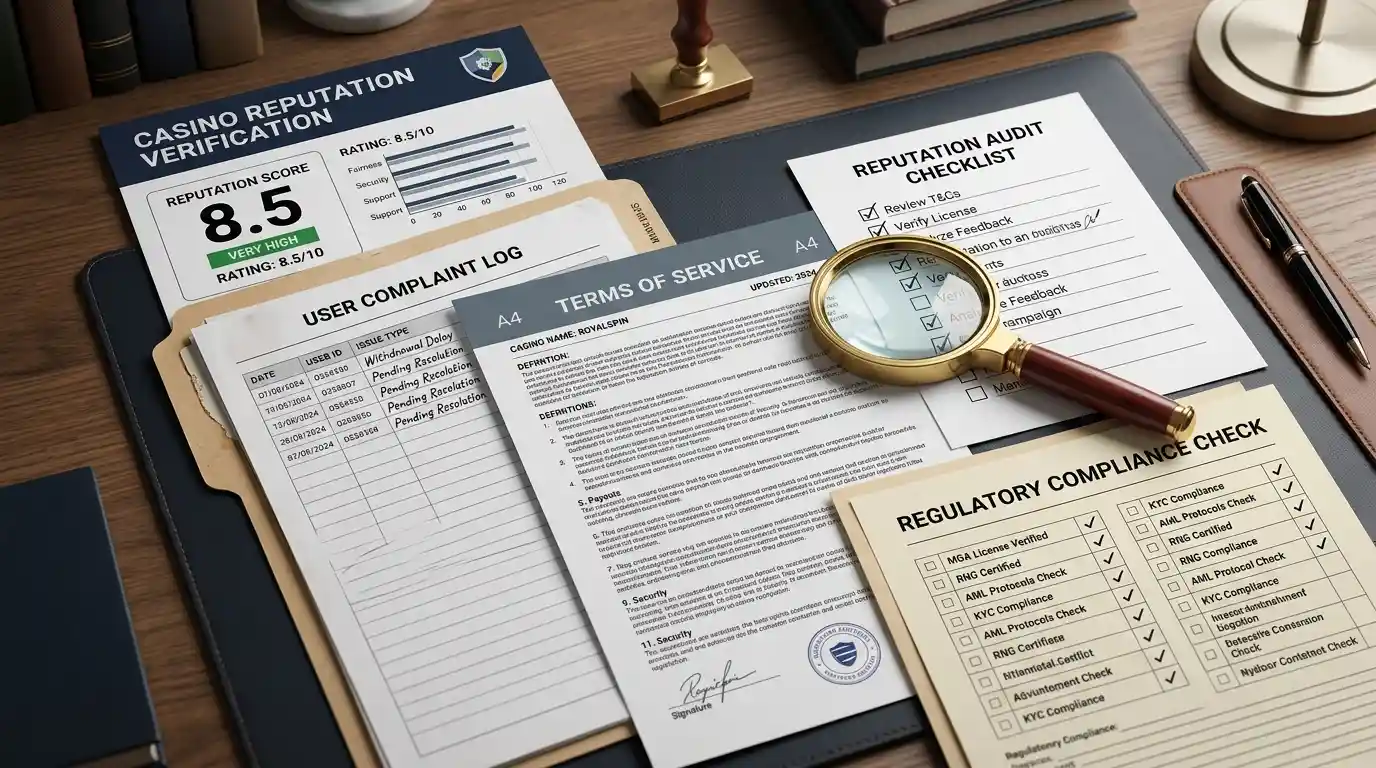
Table of Contents
- Casino Guru rating and complaint context
- The UK complaint that deserves context
- What withdrawal complaints can and cannot tell you
- How to read a complaint record
- Complaints and licensing answer different questions
- What not to infer from public complaints
- Look for patterns, not just dramatic outcomes
- What to keep if a dispute starts
- Account closure and withdrawal disputes need different questions
- Read the outcome, not only the complaint title
- The latest third-party snapshot adds useful context
- A separate regulator action in Australia is not a UK finding
- Complaint totals need a denominator that public databases do not provide
- Regulator actions and mediation records carry different weight
- Freshness matters when a brand is young
- How to use complaint history
Casino Guru rating and complaint context
The current Casino Guru TenoBet review shows a Safety Index of 4.1 and categorises it as Low. Casino Guru says the score reflects factors including terms and complaint history. It is one third-party assessment, not a UK Gambling Commission finding or proof that every customer will have the same experience.
A regulator register establishes licensing status, a complaint records an individual dispute, operator terms define contractual rules and Casino Guru’s Safety Index reflects its own methodology. None should be used as a substitute for the others.
The UK complaint that deserves context
A Casino Guru complaint submitted in June 2026 describes a player from the United Kingdom whose account was verified and later closed after a dispute involving sports-betting winnings. The complaint says the player believed UK restrictions were cited after registration and verification had already taken place. Casino Guru marks the case Closed, but its complaint team also states that it did not have enough expertise or tools to assess the sports-betting dispute fairly.
For the conflicting signals around UK account acceptance, see UK access evidence. A complaint can show what happened to one account, but it cannot define the current terms for every UK resident.
What withdrawal complaints can and cannot tell you
Tenobet uses KYC/account verification, but complaint headlines do not establish exact withdrawal limits, method-specific processing times or fees.
For payout methods and timing factors, see Tenobet withdrawals. Complaint history is useful for spotting recurring themes, but it is not a payout timetable.
How to read a complaint record
- Check the case status. Resolved, rejected, unresolved and closed-for-other-reasons do not mean the same thing. Read the reason, not only the label.
- Read both sides of the dispute. A player’s account describes what that person says happened; check the operator response and case outcome where available.
- Identify the rule in dispute. If a case involves country eligibility, KYC or withdrawals, compare it with the current terms that govern that issue.
- Compare dates. A complaint can describe terms or account behaviour that later changed. Newer cases are generally more useful when checking present-day conditions.
- Avoid prevalence claims from a small public sample. Complaint databases show reported cases, not the denominator of all players or all withdrawals.
Complaints and licensing answer different questions
The Tenobet licence and trust section covers the UKGC and Anjouan positions. Complaint history does not change the licence shown in a regulator register.
For a UK reader, Casino Guru’s Low Safety Index, public complaint records and the lack of a UKGC listing are separate reasons to read account terms carefully, confirm eligibility and understand withdrawal conditions before depositing.
What not to infer from public complaints
Public complaint databases are selective by nature: people with a dispute are more likely to post than people whose transactions were routine.
Use complaints to identify practical checks before risking money: country eligibility, identity verification, applicable terms and withdrawal conditions. See Tenobet registration for account setup and verification considerations.
Look for patterns, not just dramatic outcomes
One complaint can reveal a useful question without proving that the same outcome is common. Repeated disputes about the same issue deserve more attention than a single unusual case, but public complaint databases still do not show every successful withdrawal or routine account interaction.
Dates matter as well. The June 2026 UK case is relevant because it is recent and involves country eligibility, identity verification and account closure in one sequence. Its value is in showing which terms a UK user should clarify before depositing, not in turning one dispute into a universal rule for all Tenobet accounts.
What to keep if a dispute starts
Keep copies of the terms that applied when you deposited or accepted a promotion, together with transaction references, account messages and any KYC request. If the dispute concerns a withdrawal, record the amount, selected method, request date and any status shown in the cashier.
When contacting support, describe the event in chronological order and ask for the specific term or account rule being applied. That makes it easier to distinguish a payment delay, KYC review, country-eligibility issue or promotion dispute instead of treating every problem as the same type of complaint.
Account closure and withdrawal disputes need different questions
If an account is closed, first identify the rule the operator says was breached and whether funds remain in the account. If a withdrawal is delayed, focus on the method, KYC state, transaction reference and any stated processing stage. Those details are more useful than applying one complaint label to every kind of dispute.
Read the outcome, not only the complaint title
A closed case can mean different things. Read whether the dispute was resolved, rejected, withdrawn or closed because the complaint service could not assess the issue.
The latest third-party snapshot adds useful context
Casino Guru’s July 2026 TenoBet page still shows a Safety Index of 4.1, labelled Low. At the time of the latest check, its database displayed seven unresolved complaints, alongside resolved and rejected cases. That count is a live third-party snapshot rather than a regulator statistic, so it can change as cases are opened, closed or reclassified.
The same page says the casino does not cooperate with Casino Guru’s complaint specialists on submitted complaints. That is relevant to the usefulness of that particular mediation channel, but it should not be stretched into a claim about every support interaction or every withdrawal.
A separate regulator action in Australia is not a UK finding
On 31 July 2026, the Australian Communications and Media Authority published a formal warning naming Softon Ltd and the brands Gambiva and TenoBet. ACMA’s later quarterly enforcement report says Softon Ltd was warned for providing prohibited and unlicensed regulated interactive gambling services in Australia.
This is a concrete regulator action and is stronger evidence than an anonymous forum allegation, but its jurisdiction matters. It concerns Australian law and Australian consumers. It does not create a UKGC licence finding, determine whether every UK account is eligible, or prove the outcome of an individual player’s complaint. For a UK reader it belongs in the broader reputation picture as evidence that regulatory questions are not confined to user-review websites.
Complaint totals need a denominator that public databases do not provide
Seven unresolved complaints can sound large or small depending on how many customers and withdrawals occurred during the same period, and that denominator is not available from the complaint page. Without it, the number is a warning signal rather than a measurable failure rate.
A better use of the database is to inspect the themes and outcomes. Repeated account-closure or withdrawal disputes tell you which terms to read and which records to preserve. They do not allow a responsible article to say that a fixed percentage of Tenobet users will encounter the same issue.
Regulator actions and mediation records carry different weight
ACMA’s formal warning is an official enforcement document within Australia. Casino Guru cases are a private dispute-resolution and review source. Player posts are first-person allegations. Each can be useful, but their evidential roles are different.
When several sources point in the same direction, describe that convergence carefully rather than merging them into one stronger-sounding claim. A regulator action should be cited for what the regulator actually found; a complaint should be cited for what the player reported and how the case ended.
Freshness matters when a brand is young
Tenobet launched in 2025, so a large share of its public reputation history is necessarily recent. That makes dates especially important: a 2026 regulator action or complaint record can be more relevant to present conditions than an older promotional review, while still requiring careful attribution.
For any new complaint you find, compare the submission date, the disputed event date and the final case status before using it as evidence.
How to use complaint history
Casino Guru’s 4.1 Low Safety Index and its complaint records are third-party assessments rather than regulator conclusions. The June UK case highlights the interaction between eligibility, verification and account closure, but the complaint team closed it without deciding the sports-betting dispute on its merits.
Use complaint history to decide what to check before depositing: licence status, current country terms, KYC requirements and withdrawal conditions.
For related context, see full Tenobet UK review.
Prepared by the Tenobet Casino 2 editorial staff.